February 2, 2026
Hnefatafl: The Viking 'Chess' That Came First
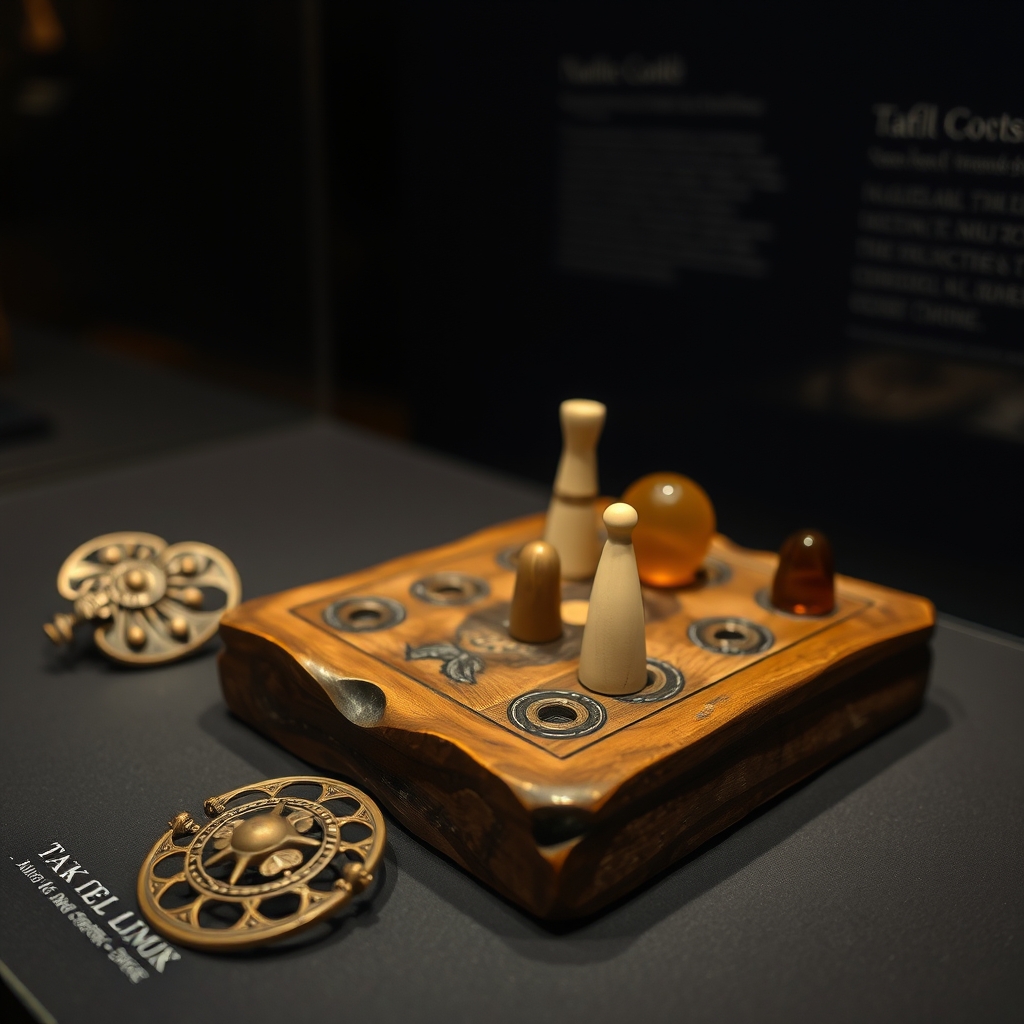
It is often called “Viking chess,” and the nickname is useful shorthand. But it is also misleading, because Hnefatafl is not chess at all, and in the Norse world it came first. For centuries before chess reached northern Europe, the King’s Table was the strategy game of choice across Scandinavia and the lands the Vikings touched. To understand it is to understand a way of thinking about conflict quite different from the balanced armies of the chessboard.
An uneven fight
The defining feature of Hnefatafl is its asymmetry. The two sides are not mirror images. One player commands a king, who begins at the center of the board on a special throne square, surrounded by a guard of defenders. The other player commands an attacking force roughly twice as large, arranged around the edges of the board.
The defenders are outnumbered, but they have a goal the attackers cannot match: the king must escape. The defending side wins by getting the king to safety, typically a corner square, while the attacking side wins by surrounding and capturing him before he breaks free. It is a contest of breakout against blockade, the few against the many, and the two sides must think in entirely different ways. The attacker presses inward like a closing net; the defender probes for the gap.
How the pieces move
The mechanics are simple and quickly learned. Every piece moves like the rook in chess, in a straight line along ranks and files for as many empty squares as the player wishes. Pieces cannot move diagonally and cannot leap over one another. Capture happens not by landing on an enemy but by flanking: when a piece moves so that an opposing piece is trapped between two of its own, the trapped piece is removed. The king himself is unarmed and cannot capture, which makes his defenders’ work all the more pressing.
Because the rules are compact and the equipment simple, the game traveled easily. A board could be scratched into wood or stone, and a handful of pieces carried anywhere. This is part of why the Vikings spread it so widely. You can read the game’s full background in our Hnefatafl history.
Carried across the seas
The archaeological trail runs deep. A board fragment from Vimose in Denmark predates 400 CE, and a runestone at Ockelbo in Sweden, carved around 800 CE, shows two players at a tafl board. As the Norse sailed and settled, the game put down roots under local names: Brandubh in Ireland, Ard Rí in Scotland, Tawlbwrdd in Wales, Tablut in Sámi lands, and Hnefatafl in Iceland. They are all recognizably the same game.
Hnefatafl reigned until the eleventh century, when the steady advance of chess across Europe pushed it toward obscurity. Chess offered balanced sides and a wider cast of pieces, and it gradually displaced the older game so thoroughly that some of Hnefatafl’s exact rules had to be reconstructed from fragmentary later evidence, most famously a Sámi version recorded by the botanist Linnaeus in the eighteenth century.
Yet the game has never truly died, and its asymmetric tension feels strikingly modern. To play it is to feel the pressure the Norse felt: the trapped king straining for the edge, the tightening ring of attackers. If you would like to take up the King’s Table yourself, our museum-quality Hnefatafl set is ready for the first move.