Viking · History
The History of Hnefatafl
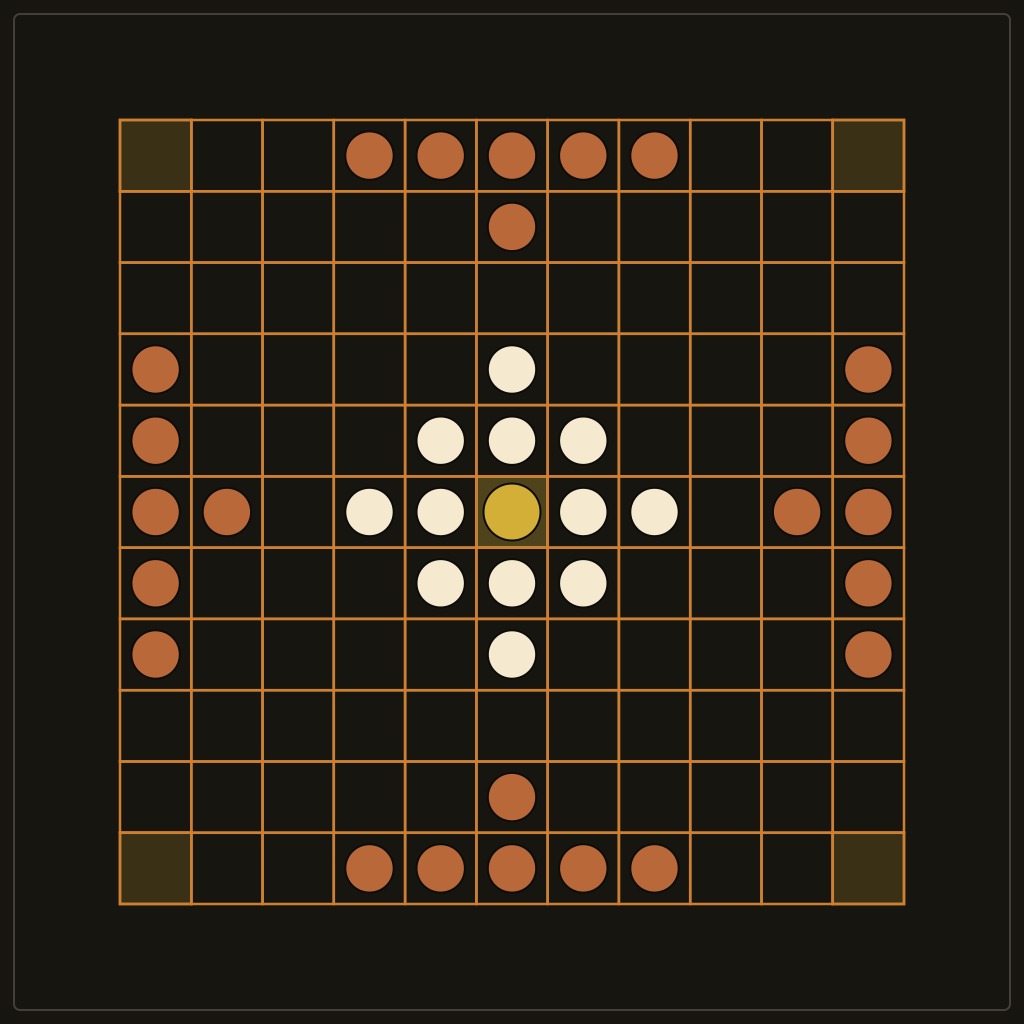
- Period
- c. 400-1100 AD
- Origin
- Scandinavia
- Players
- 2
- Play time
- 15-30 min
- Difficulty
- Medium
Long before chess reached the cold harbors of the North, the people of Scandinavia gathered around a different battlefield carved in wood and bone. They called it Hnefatafl, roughly “the king’s table,” and for some seven centuries it was the premier strategy game of the Norse world.
A game of the tafl family
Hnefatafl belongs to a wider group of board games scholars call tafl (the Old Norse word for “table” or “board”). These games shared an unusual design: they were asymmetric. One side commanded a king and a small bodyguard fighting to break free; the other fielded roughly twice as many attackers trying to trap him. No other game tradition of the era pitted such uneven forces against one another, and the theme of a beleaguered chieftain cutting his way to safety carried weight in a warrior culture built on raids, sieges, and loyalty to a lord.
The family spanned the Norse diaspora. In Wales the game was known as tawlbwrdd. In Lapland a later variant called tablut survived long enough to be recorded in the eighteenth century by the naturalist Carl Linnaeus, whose notes remain our single most detailed account of how any tafl game was actually played.
How we know the Vikings played
No Viking ever wrote down the rules of Hnefatafl, or if they did, the record has not survived. Almost everything we know comes from archaeology and scattered references in the sagas. Gaming pieces of glass, amber, and bone turn up across the Norse world, from Scandinavia to the British Isles and Ireland.
Among the most celebrated finds is the gaming board recovered from the Gokstad ship burial in Norway, a reminder that a fine board was a possession worth carrying into the afterlife. A wooden board fragment from a tenth-century crannog at Ballinderry, Ireland, preserves a marked playing surface, while the Ockelbo runestone in Sweden depicts two figures seated at a tafl game. The sagas, too, treat skill at tafl as a mark of a cultivated noble, listing it alongside poetry and swordsmanship among a leader’s accomplishments.
Because the rules were never fixed in writing, modern reconstructions necessarily fill gaps with informed conjecture, drawing on Linnaeus’s tablut notes and the surviving boards to rebuild a game that was once second nature to thousands.
The coming of chess
Hnefatafl’s long reign ended not in defeat but in fashion. As trade and travel knit medieval Scandinavia more tightly to continental Europe, a newer game arrived from the south by way of the Islamic world and Christendom: chess. Symmetrical, prestigious, and well developed, chess offered the aristocracy a fresh diversion, and over the late medieval centuries it steadily displaced the old king’s table.
By the 1500s Hnefatafl had all but vanished from living memory, its rules surviving only in fragments. Yet the game’s lopsided struggle of one king, a loyal few, and a closing ring of enemies has drawn players back across the centuries, restoring to the table a contest the Norse once knew as well as the sea.