Royal Game of Ur · Rules
How to Play the Royal Game of Ur
2 players · 20-30 min
The rules below follow the reconstruction proposed by Irving Finkel of the British Museum, drawn from an ancient cuneiform tablet and the surviving boards. Because no complete ancient rulebook survives, these are a well-supported reconstruction rather than certainty, but they make for a fast and tense game.
The Objective
Each player races to move all seven of their pieces along their own path across the board and bear them off the far end. The first player to remove all seven pieces wins. It is a contest of luck and judgment in roughly equal measure.
Setup
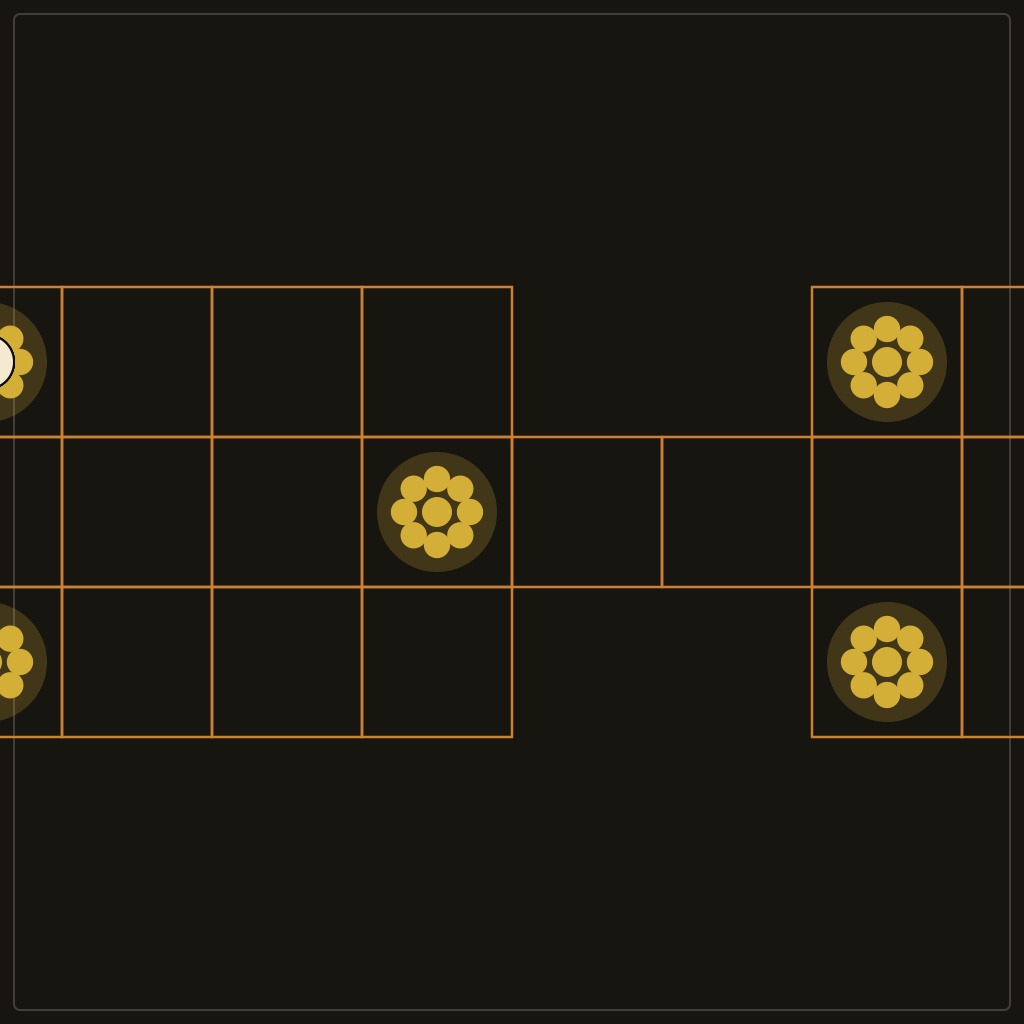
The board has twenty squares in two blocks joined by a central bridge. Each player takes seven pieces of one color and a set of dice. Both players share the central column of squares, while the outer columns belong to each player alone. Pieces begin off the board and enter as the dice allow.
The Tetrahedral Dice
You roll four tetrahedral (four-sided, pyramid-shaped) dice. Two of the four corners on each die are marked. After a roll, count how many marked corners land facing up across all four dice. That total is how many squares you may move:
- 0 marked corners: you forfeit your turn (move nothing).
- 1, 2, or 3: move a piece that many squares.
- 4 marked corners: move a full four squares.
Moving & Rosettes
On your turn, use your roll to either bring a new piece onto the board or advance one already in play, following your route along the outer column, through the shared middle, and out. You cannot land on a square already occupied by one of your own pieces.
The five rosette squares are special. Landing exactly on a rosette grants you an immediate extra roll. The rosette on the central shared square (and the rosettes generally, in most readings) also acts as a safe square: a piece resting on a rosette cannot be captured.
Capturing
The shared middle column is the battleground. If you land on a square occupied by an opponent’s piece, you capture it: that piece is removed from the board and must start its journey over from the beginning. A piece sitting safely on a rosette, however, is protected and cannot be sent back.
Winning
To bear a piece off, you must roll the exact number needed to move it past the final square; an overshoot simply means you move a different piece instead. The first player to march all seven pieces off the board claims victory.