Aztec · History
The History of Patolli
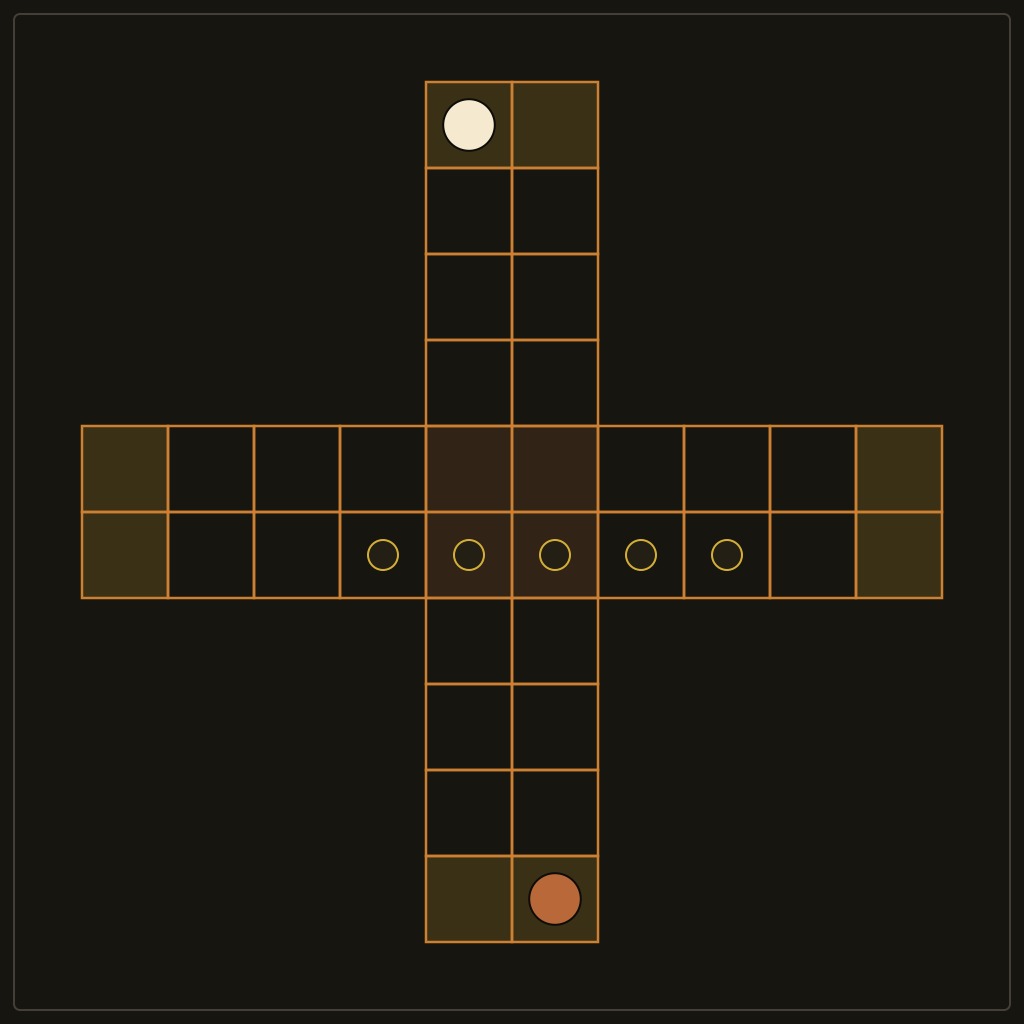
- Period
- pre-1521 (Mesoamerica)
- Origin
- Mesoamerica (Aztec, Maya, Teotihuacan)
- Players
- 2-4
- Play time
- 30-60 min
- Difficulty
- Medium
Few games carried as much excitement, and as much risk, through the markets and households of ancient Mexico as Patolli. A racing game of great antiquity, it was played across Mesoamerica for well over a thousand years, its cross-shaped board scratched into mats, leather, and stone from the Maya lowlands to the central city of Teotihuacan and, finally, the streets of the Aztec capital, Tenochtitlan.
A game of deep antiquity
Patolli belongs to the family of race games, in which players move pieces along a track from start to finish. Its roots reach back many centuries before the Aztecs rose to power. Murals and incised boards at Teotihuacan, the metropolis that grew from roughly the first century onward, preserve the cross or X-shaped track, which shows that the game was already well established long before it reached its most famous players.
The board itself was rarely a permanent object. It was commonly painted on a straw mat or a piece of leather, or carved directly into a floor or tabletop. Movement was decided not by carved dice but by five black beans, each drilled with a hole or marked on one face. A player cast the beans and counted how many landed marked-side up: a humble piece of agricultural produce turned into an instrument of chance.
Gambling under the god of games
To the Aztecs, Patolli was above all a gambling game, and the stakes could be ruinous. Players wagered goods of every kind: blankets, precious stones, cacao beans, fine feathers, even their own homes and, in extreme cases, their freedom. Crowds of onlookers gathered around the players, themselves betting on the outcome, and the most devoted carried their beans and gaming mats with them wherever they went.
This was no idle pastime but an act tied to religious meaning. The game fell under the patronage of Macuilxochitl, the god of games, gambling, music, and dance, also known as Xochipilli, the “Prince of Flowers.” The Codex Magliabechiano records that players invoked him before play, sometimes scattering incense or calling on the Five Flowers for favor. To gamble at Patolli was, in a sense, to place oneself in the hands of a deity.
Witnessed and then erased
Much of what we know comes from the Spanish chroniclers who arrived in the sixteenth century. The Dominican friar Diego Durán described the crowds of spectators and the feverish betting, while Bernardino de Sahagún, in his survey of Aztec life, recorded the game among the customs of the people he sought to document.
Yet the same Spanish presence that preserved these accounts also worked to destroy the game. Viewing Patolli as both a vice and a form of idolatry tied to forbidden gods, colonial authorities suppressed it, burning the mats and boards and punishing players. The painted surfaces and leather mats left almost no archaeological trace, so that today Patolli survives chiefly through chronicles, codices, and the carved crosses of vanished cities: a game whose precise rules we must partly reconstruct from the silence the conquest left behind.