Nine Men's Morris · Rules
How to Play Nine Men's Morris
2 players · 10-20 min
The Objective
Nine Men’s Morris is a game for two players. Your goal is to form mills (rows of three of your own pieces) which let you remove your opponent’s pieces from the board. You win by reducing your opponent to two pieces, or by leaving them with no legal move.
Setup
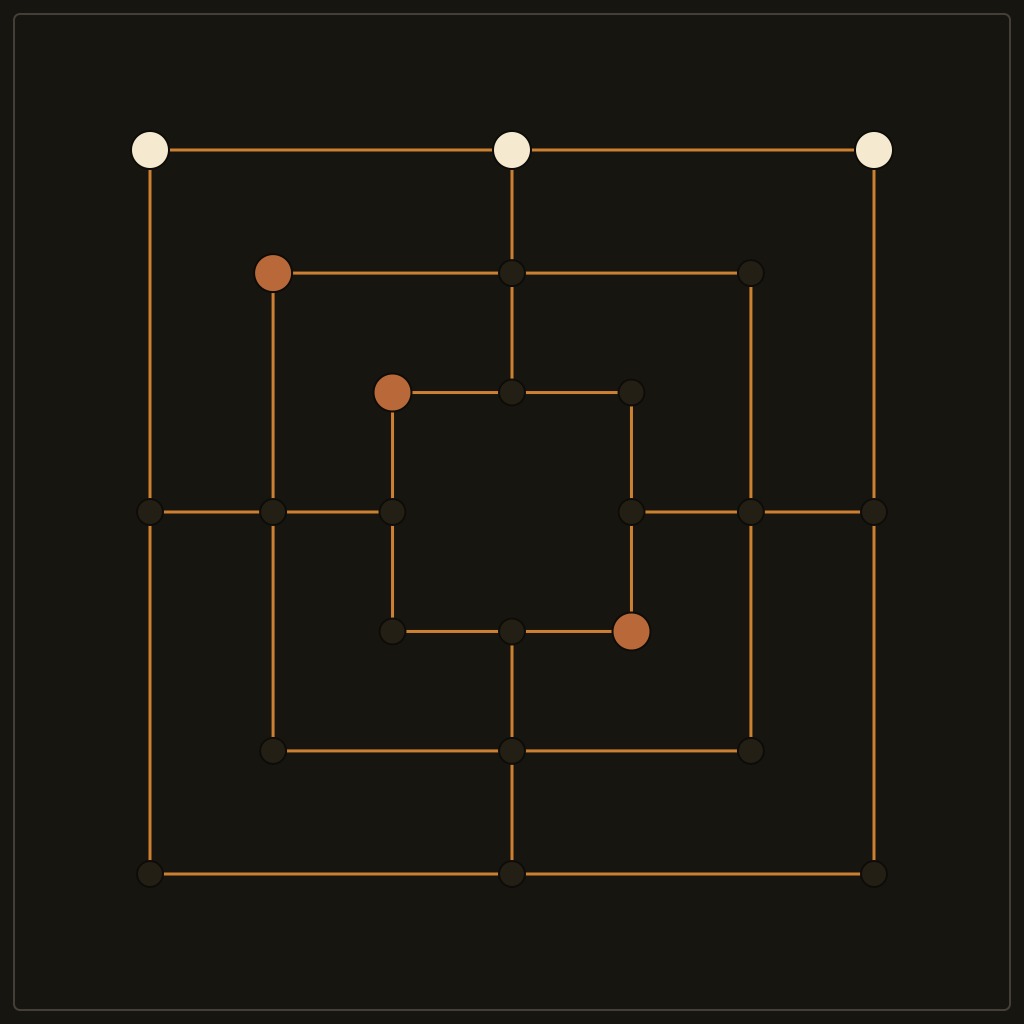
The board is three nested squares joined by lines crossing the middle of each side, creating 24 points where lines meet or cross. Each player takes nine pieces of a single color. The board starts empty.
Phase 1: Placing
Players take turns, one piece at a time, placing a piece on any empty point. This continues until all 18 pieces have been placed. Even in this phase, completing a mill lets you capture (see below), so think ahead, because a strong opening shapes the whole game. Try to occupy points where lines cross, as these connect to the most neighbors.
Phase 2: Moving
Once all pieces are on the board, players take turns moving one piece along a line to an adjacent empty point. Pieces may not jump over others or move along a line to a non-adjacent point. The aim now is to open and re-form mills by sliding pieces in and out of rows.
Mills & Capturing
A mill is three of your pieces in a straight line along the board’s marked lines (the diagonals do not count in the standard game). Whenever you form a mill, by placing or by moving, you immediately remove one of your opponent’s pieces from the board.
You may not remove a piece that is part of an opponent’s mill, unless all of their pieces are in mills, in which case any may be taken. Captured pieces are gone for good and are not returned.
A common and useful tactic is the “running mill,” where you move a piece back and forth between two positions, breaking and re-forming the same mill on alternate turns to capture a piece each time.
Winning
The game ends, and you win, when your opponent is reduced to two pieces (too few to ever make a mill), or when your opponent cannot make a legal move on their turn.
Optional rule, flying: Many players agree that once a player is down to three pieces, that player may “fly,” moving a piece to any empty point rather than only an adjacent one. Flying gives the losing player a fighting chance; decide before the game whether you will use it.