Mehen · Rules
How to Play Mehen
2-6 players · 15-30 min
A game partly lost to time
Before setting out any rules, an honest caveat: the original rules of Mehen did not survive. No ancient Egyptian text explains how the game was won or how its pieces moved, and the surviving boards differ so widely in their number of segments that no single standard can be recovered. What follows is a plausible modern reconstruction, built from the coiled-serpent boards, the carved lion and lioness pieces, and the marble tokens found in Old Kingdom tombs. Treat it as a faithful interpretation, not a recovered original, and feel free to adjust it for your own table.
The objective
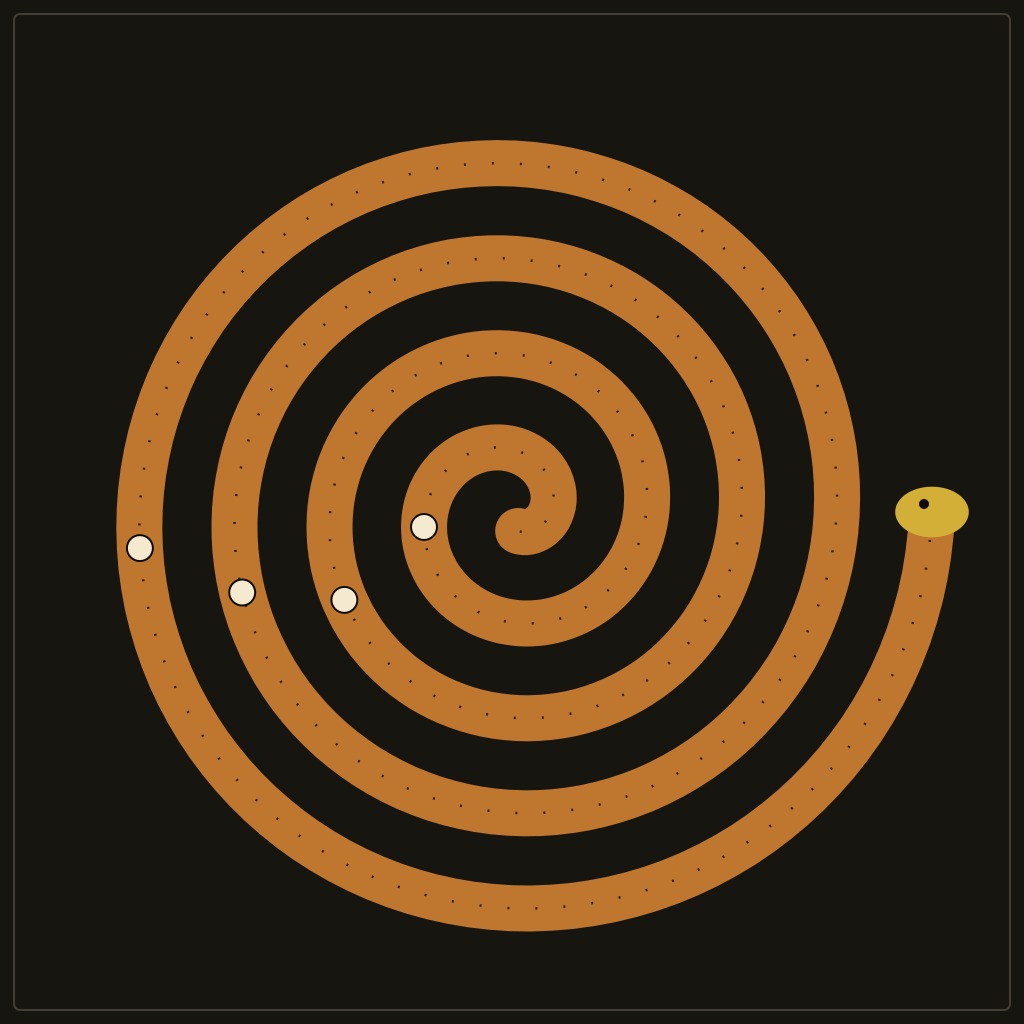
Mehen is understood to be a race game. Each player moves their pieces along the spiral body of the serpent, traveling from the tail at the outer rim toward the head at the center. The goal is to guide your tokens through the full length of the coil and reach the snake’s head before your opponents.
Setup
Two to six players gather around the coiled board. Distribute the pieces:
- Each player takes a set of six marbles in a single color.
- The lion and lioness pieces (three of each) are shared as special markers used during play.
- All pieces begin off the board, waiting to enter at the tail on the outer edge of the spiral.
Agree before you start on how movement will be decided. The Egyptians likely used casting sticks or knucklebones; a single six-sided die works just as well for modern play.
Movement (modern reconstruction)
On your turn, cast your sticks or roll your die and move one marble that many segments along the coil, always traveling inward from tail toward head. Each player races their marbles one at a time through the spiral.
The lion and lioness pieces are awarded to players who finish moving a full set of marbles to the center; in this reconstruction, a player who has brought their marbles home may then run a lion piece back along the coil, free to send rival marbles back toward the tail if it lands on them. The lions are the predators of the track, a reward for the swift and a hazard for the slow.
Only one marble may occupy a segment at a time. If your roll would land you on a segment already held by an opponent, that piece is bumped back toward the tail; if the segment holds your own piece, you must move a different marble instead.
Winning
The first player to bring all of their marbles along the full length of the serpent and home to the head at the center wins the game. In a longer session, players may agree that the winner is the one who completes the race and also survives the run of the lions without being driven back, a final test of fortune at the heart of the coiled god.