Ludus Latrunculorum · Rules
How to Play Ludus Latrunculorum
2 players · 20-40 min
Ludus Latrunculorum is a two-player game of strategy in which each side commands a small army of pieces, seeking to outmaneuver and capture the enemy. Before learning the rules below, it is worth knowing that no complete ancient ruleset survives. The Romans left only literary hints and excavated boards, so what follows is a reconstruction, most commonly the ruleset popularized by R. C. Bell, rather than a verbatim ancient text.
The objective
Your goal is to capture or immobilize your opponent’s soldiers through better positioning. Victory belongs to the player who reduces the enemy force until it can no longer resist, usually by capturing most of their pieces or trapping the survivors so they cannot move.
Setup
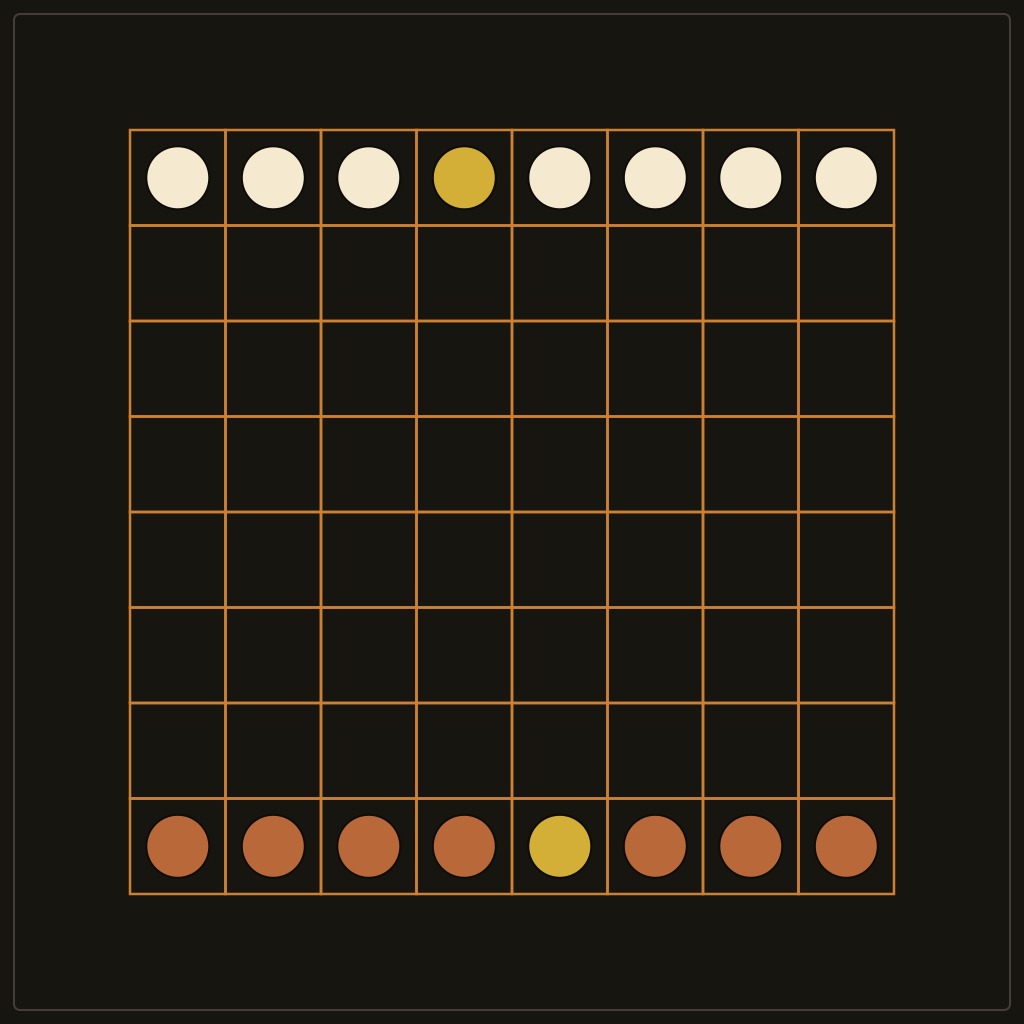
Play takes place on a gridded board; an 8×8 grid is a common and convenient choice, though historical boards varied in size. Each player takes a set of identical counters in their own color, traditionally black and white glass. The two armies are placed on opposing back rows, or arranged along opposite edges of the board, so the forces face one another across an empty field.
How pieces move
All soldiers move the same way. A piece slides orthogonally, horizontally or vertically, across any number of empty squares, much like the rook in chess. Pieces may not move diagonally, and they may not jump over other pieces, friendly or enemy. Only one move is made per turn, and players alternate turns.
Custodial capture
There is no capture by landing on an enemy piece. Instead, latrunculi uses custodial capture, the flanking method described by Roman writers. You capture an enemy soldier by surrounding it on two opposite sides (front and back, or left and right) with two of your own pieces along a rank or file. The trapped piece is removed from the board.
Note that the capture is active: it occurs when you move a piece into the flanking position. A piece that voluntarily moves into the gap between two enemy soldiers is generally considered safe, since it placed itself there rather than being trapped. A single move that completes flanks on more than one enemy may capture several pieces at once.
Winning
You win by grinding down the enemy army. The game ends when one player has captured enough of the opponent’s soldiers, or so thoroughly immobilized the remaining pieces, that no meaningful resistance is possible. Because the rules are reconstructed, groups often agree in advance on the exact victory condition, whether that is capturing all enemy pieces, reaching a set threshold, or leaving the opponent with no legal move.