Medieval · History
The History of Fox & Geese
- Period
- c. 1300s onward
- Origin
- Northern Europe / Scandinavia
- Players
- 2
- Play time
- 10-20 min
- Difficulty
- Easy
A hunt across the cross-shaped board
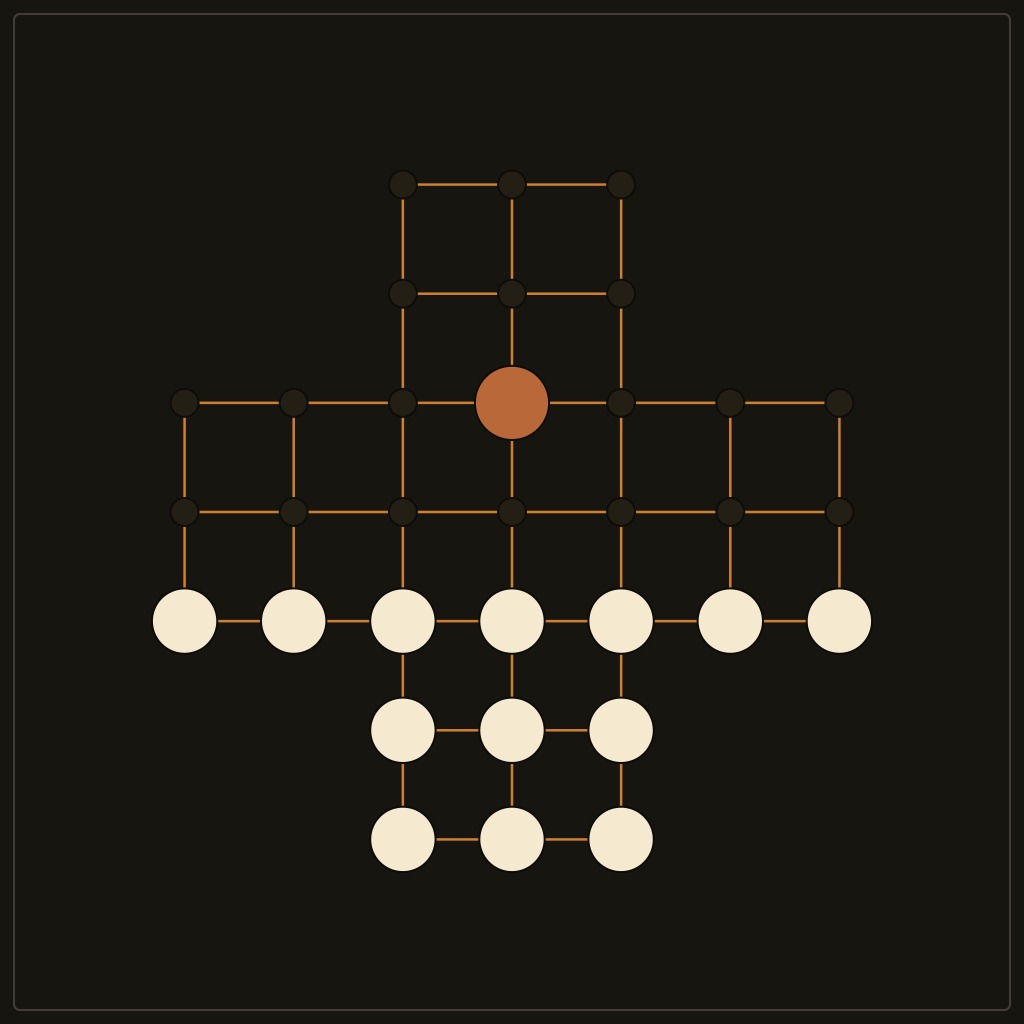
Fox & Geese belongs to an old family of asymmetric contests known as hunt games, in which two unequal forces face one another across the board. On one side is a single predator; on the other, a flock of outnumbered prey that must rely on cooperation rather than strength. This lopsided drama plays out on a distinctive cross-shaped board of thirty-three points, joined by lines along which the pieces travel. The board’s open arms give the lone fox room to maneuver, while the geese press forward as a wall, trading individual weakness for collective discipline.
The game’s lineage reaches back to the tafl family, the broad tradition of Northern European strategy games that includes the Viking war game hnefatafl. Like its tafl relatives, Fox & Geese sets the few against the many and rewards positional cunning over the simple counting of forces. Where hnefatafl dramatized a king fleeing his attackers, Fox & Geese inverts the theme into a tale of the hunt.
Norse roots and the Grettis Saga
Scholars trace the game’s ancestry to Scandinavia, where it likely emerged as a variant of the older tafl games. The Old Norse term halatafl, meaning roughly “tail board” (the “tail” thought to evoke a fox’s brush), appears in the fourteenth-century Icelandic Grettis Saga, the saga of Grettir the Strong. Many historians read this reference as one of the earliest mentions of Fox & Geese, though others caution that halatafl may instead describe a board used for another tafl variant. The ambiguity is itself a window into a world where these games shaded into one another, passed down by hearth and memory rather than written rulebooks.
From a king’s accounts to the Victorian parlor
The earliest uncontested record of Fox & Geese comes not from a saga but from a royal ledger. The account books of King Edward IV of England (reigning 1461 to 1470 and 1471 to 1483) record the purchase of two silver foxes and twenty-six geese, pieces enough for two complete sets. This entry confirms that by the fifteenth century the game was valued enough to be crafted in precious metal for the English crown.
From there Fox & Geese spread widely across medieval and later European society, scratched onto boards by laborers and rendered in fine materials for the wealthy. Its popularity lasted for centuries, reaching a particular height in the Victorian era, when it ranked among the favorite parlor pastimes of Queen Victoria herself. Simple enough to learn in a moment yet subtle enough to reward repeated play, the game survived the rise and fall of countless fashions. Today it remains a link to the long Northern tradition of the hunt rendered in wood, bone, and silver, a contest of one against many that has occupied players for more than seven hundred years.