January 5, 2026
The 10 Oldest Board Games in the World
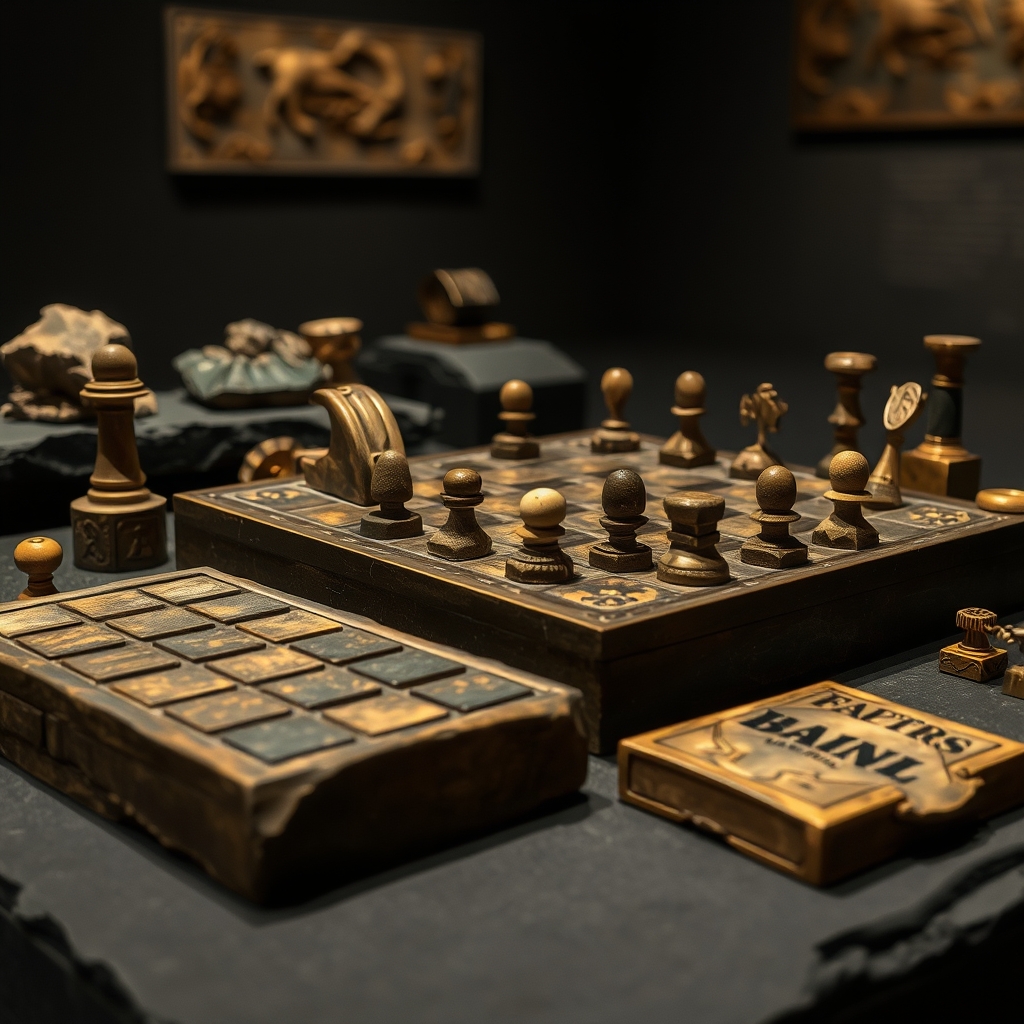
Long before printed cards or plastic tokens, before chess or backgammon had names, people gathered around boards scratched into stone, painted on wood, or pressed into clay. The instinct to play a structured game is among the oldest we can document. What follows is a countdown through some of the earliest games archaeologists have recovered from the ground, each one a window into how ancient people thought about chance, strategy, and fate.
From the Nile to the Tigris
The two giants of early gaming come from the great river civilizations. Senet, the Egyptian race game, appears in the archaeological record around 3100 BCE and may be older still. Played across thirty squares in three rows of ten, it used casting sticks rather than dice and eventually acquired a religious dimension, becoming a symbolic journey through the underworld. Complete sets have been recovered from royal tombs, including that of Tutankhamun.
Older yet as a fully playable game is the Royal Game of Ur, excavated by Sir Leonard Woolley in the 1920s from the Royal Cemetery at Ur in modern Iraq and dated to roughly 2600 BCE. Its rules survived on a cuneiform tablet written in 177 BCE and were reconstructed in the 1980s by British Museum curator Irving Finkel. You can read more about that decoding in our Royal Game of Ur history.
Other early Egyptian games round out the picture. Mehen, “the coiled one,” took the form of a spiraling snake divided into segments and was popular through the Old Kingdom before fading from use late in the third millennium BCE. Hounds and Jackals, named by Howard Carter after the carved pegs used as playing pieces, used a board pierced with fifty-eight holes. One famous set from the reign of Amenemhat IV now resides in the Metropolitan Museum of Art.
Games of war and the crossing north
As civilizations grew more martial, so did their games. The Greeks played Petteia, a game of capture that Plato invoked as a metaphor for disciplined strategy. The Romans inherited and refined it as Ludus Latrunculorum, the “game of little soldiers,” a dice-free contest of tactics that legionaries carried across the empire on cloth and lightweight boards.
From the Roman world, the tradition of the hunted-piece game appears to have traveled north. The tafl family of games spread across Iron Age and Viking Age Scandinavia, the most famous being Hnefatafl, the “King’s Table.” A board fragment from Vimose in Denmark dates to before 400 CE, and the Vikings carried the game across the seas to Ireland, Britain, and beyond.
Rounding out the oldest known games are backgammon’s ancestors, including the Roman Tabula and the older Ludus Duodecim Scriptorum, both played by rolling dice and racing pieces around a track. These race games echo the Royal Game of Ur and Senet, which suggests a shared human appetite for the contest between skill and luck that stretches back to the dawn of cities.
What the boards tell us
These ten games span more than three thousand years and three continents, yet certain themes recur with striking consistency: the race against fate, the hunt for a king, the capture of a soldier. Again and again, ancient people built their anxieties and ambitions into the structure of play, and they took these games seriously enough to bury them with their dead.
Each of these games is a recoverable artifact and, remarkably, a playable one. If you would like to hold a piece of this history in your hands, explore our collection of museum-quality replicas and discover which ancient table calls to you.