October 19, 2026
The Mathematics Hidden in Ancient Games
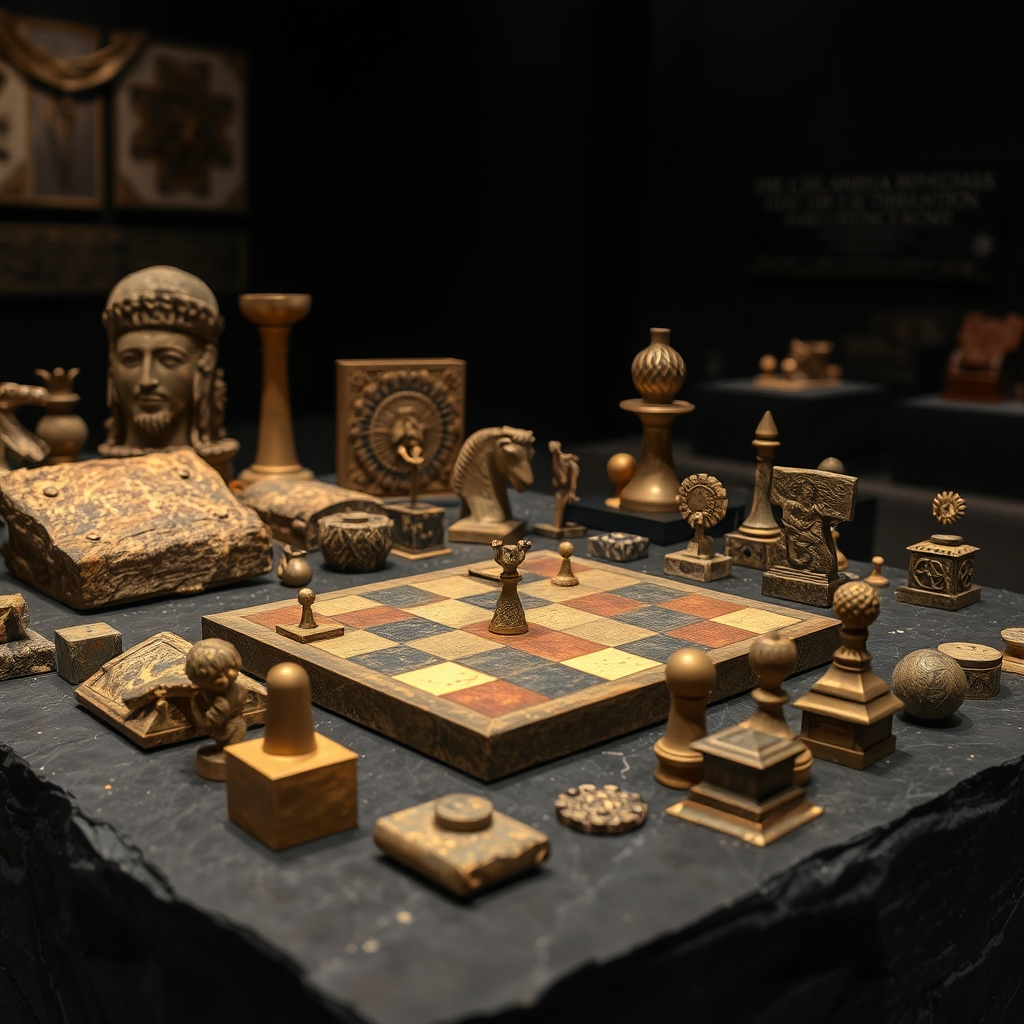
Long before anyone wrote down a theorem about probability, people were reasoning about it with their hands. The player who learned to feed pieces carefully into the danger zone, who sensed which dice rolls came up often and which came up rarely, who recognized that a certain position could never be lost, was doing mathematics, even without the vocabulary for it. Ancient boards are, among other things, instruments of mathematical thought, and they encode ideas that formal mathematics would not articulate for centuries.
The arithmetic of the dice
Consider the four pyramidal dice of the Royal Game of Ur. Each die has two marked corners and two blank ones, so each contributes a one or a zero with equal chance, and the four together produce a total from zero to four. That sounds uniform, but it is not. There is only one way to roll a zero and only one way to roll a four, while there are several distinct ways to roll a two, so a result of two is by far the most common, and the extremes are rare. This is the binomial distribution made tangible in shaped clay, three thousand years before Pascal and Fermat formalized it.
A skilled player of Ur internalizes that lopsided spread. Knowing that middling rolls dominate, you can position a piece so that the likely throw lands it safely on a rosette rather than past it. The intuition is statistical even when the player has never heard the word. The same reasoning governs every dice race from senet to backgammon: the geometry of the randomizer dictates the shape of good strategy.
Symmetry, solution, and the inevitable draw
The games that use no dice expose a different branch of mathematics, combinatorial game theory, the study of perfect information and optimal play. Nine Men’s Morris, an ancient game played since at least the Roman Empire, is a clean example. Its board of twenty-four points is full of symmetry, and that symmetry is more than decoration: rotations and reflections collapse many positions into one, which is exactly what lets the game be analyzed exhaustively.
In 1996 it was, in fact, exhaustively analyzed. Researchers solved Nine Men’s Morris by building endgame databases of roughly ten billion positions and then searching forward from the opening, proving that with perfect play by both sides the game is a draw. It was a landmark: one of the first non-trivial games solved where almost the entire state space had to be examined directly, with little help from clever shortcuts. An ancient pastime scratched into Roman roof tiles turned out to hold a problem worthy of modern computation, and a definite, provable answer.
Old games, new questions
The lesson runs in both directions. Ancient players were, without instruments or notation, exploring probability and strategy by trial and intuition. Modern mathematicians, with their databases and proofs, keep finding that these old boards pose genuine questions about counting, about symmetry, and about the limits of foresight. The reconstruction of lost games has itself begun to lean on mathematical and computational methods, using the structure of surviving boards to constrain the space of possible rules.
To play one of these games attentively is to rediscover the reasoning that built it. Explore our museum-grade reconstruction of Nine Men’s Morris and trace, mill by mill, the path toward that perfect, provable draw.