November 23, 2026
The Ball Games and Board Games of Mesoamerica
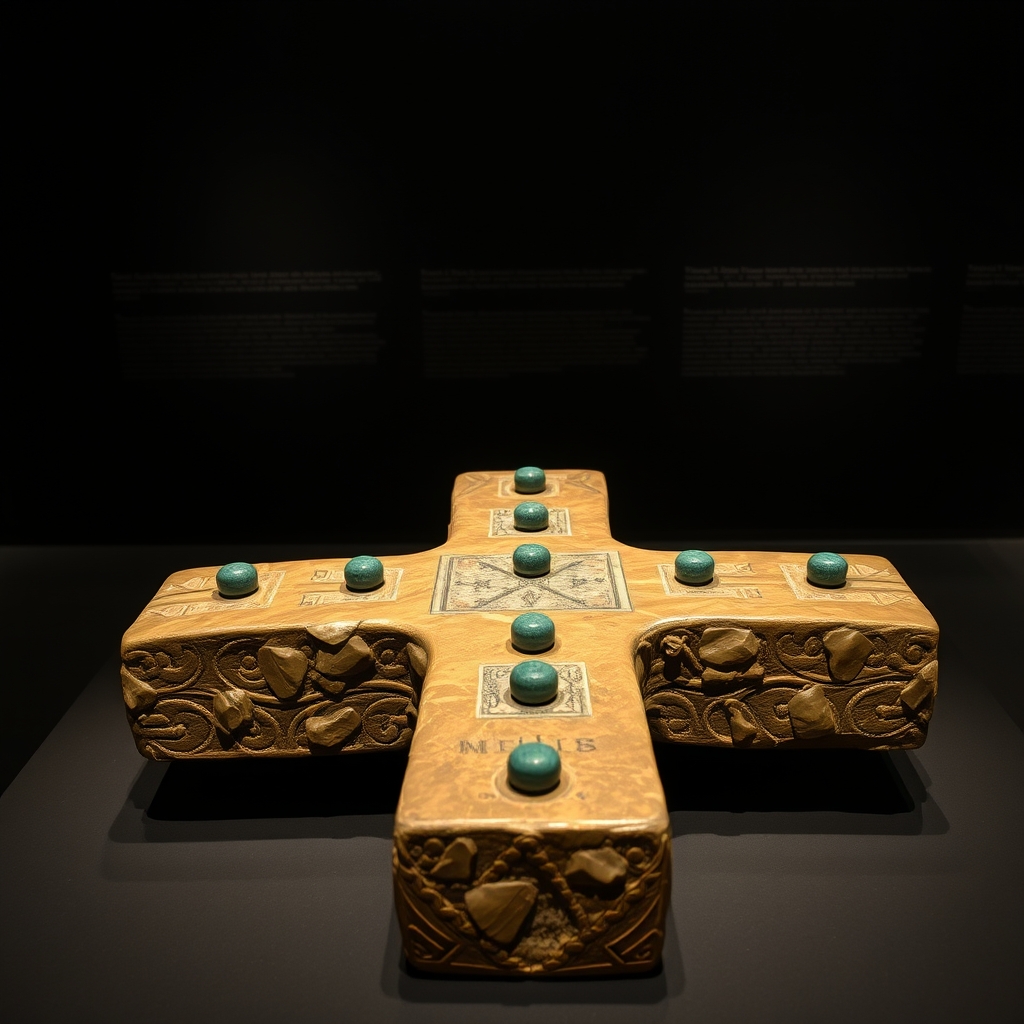
The civilizations of Mesoamerica played for the highest stakes imaginable. In the Aztec and Maya worlds, games were tied to religion, politics, gambling, and at times sacrifice. Two forms dominated: a violent, athletic ballgame staged in great stone courts, and a board game of chance and strategy played on a painted cross. Together they reveal a culture that took play as seriously as warfare, because in Mesoamerica the line between the two could be thin.
The ballgame: sport on a cosmic court
The Mesoamerican ballgame is one of the oldest organized sports on earth. The earliest evidence dates to around 1650 BC at the Olmec site of Paso de la Amada, and the game spread across nearly every Mesoamerican culture, from modern Mexico down to El Salvador. The Aztecs called it ollamaliztli in Nahuatl.
It was also the first sport in history to use a rubber ball. That ball was no toy. Made of solid latex, it could weigh as much as four kilograms, and players were forbidden to touch it with their hands or feet, striking it instead with the hip, forearm, or a racket depending on the regional variant. In the late Aztec version, driving the ball through a stone ring set high on the court wall meant instant victory, a feat so rare that legend says spectators surrendered their cloaks to a player who managed it.
The court itself, the I-shaped tlachtli, was a sacred space. The game modeled the movement of celestial bodies and the struggle between day and night, life and death. Some contests are believed to have ended in the ritual sacrifice of players, a grim reminder that this was never only sport.
Patolli: the board game of the gods
Where the ballgame was public spectacle, Patolli was intimate and addictive. It was the great board game of Mesoamerica, pervasive across the region, played on a cross-shaped board marked into squares. Players moved their pieces according to the throw of marked beans, racing around the cross in a contest of luck and judgment.
Patolli was, above all, a gambling game, and the Aztecs gambled fiercely on it. Players wagered cloth, food, precious stones, and on occasion their own freedom. It carried religious weight too, dedicated to Macuilxochitl, a god of games and pleasure, and devoted players were said to carry their beans in a pouch and invoke the deity before a throw. The Spanish, who recorded the game in horror and fascination, eventually tried to suppress it because it bound together gambling and the old religion.
What survives
The ballgame did not vanish. In parts of Sinaloa, in northwestern Mexico, indigenous communities still play a direct descendant called ulama, in forms named for the part of the body used, including ulama de cadera, the hip game. To watch it is to watch a living thread reaching back more than three thousand years.
Patolli, suppressed in its own time, survives now mainly through reconstruction from colonial accounts and surviving boards. To set one up is to recover a corner of a world the conquest tried hard to erase, a game the gods were thought to love.
The games of Mesoamerica remind us that play and the sacred were once the same thing. Explore the boards of the ancient Americas and beyond at /games.