November 16, 2026
Tafl vs. Chess: How Strategy Games Evolved
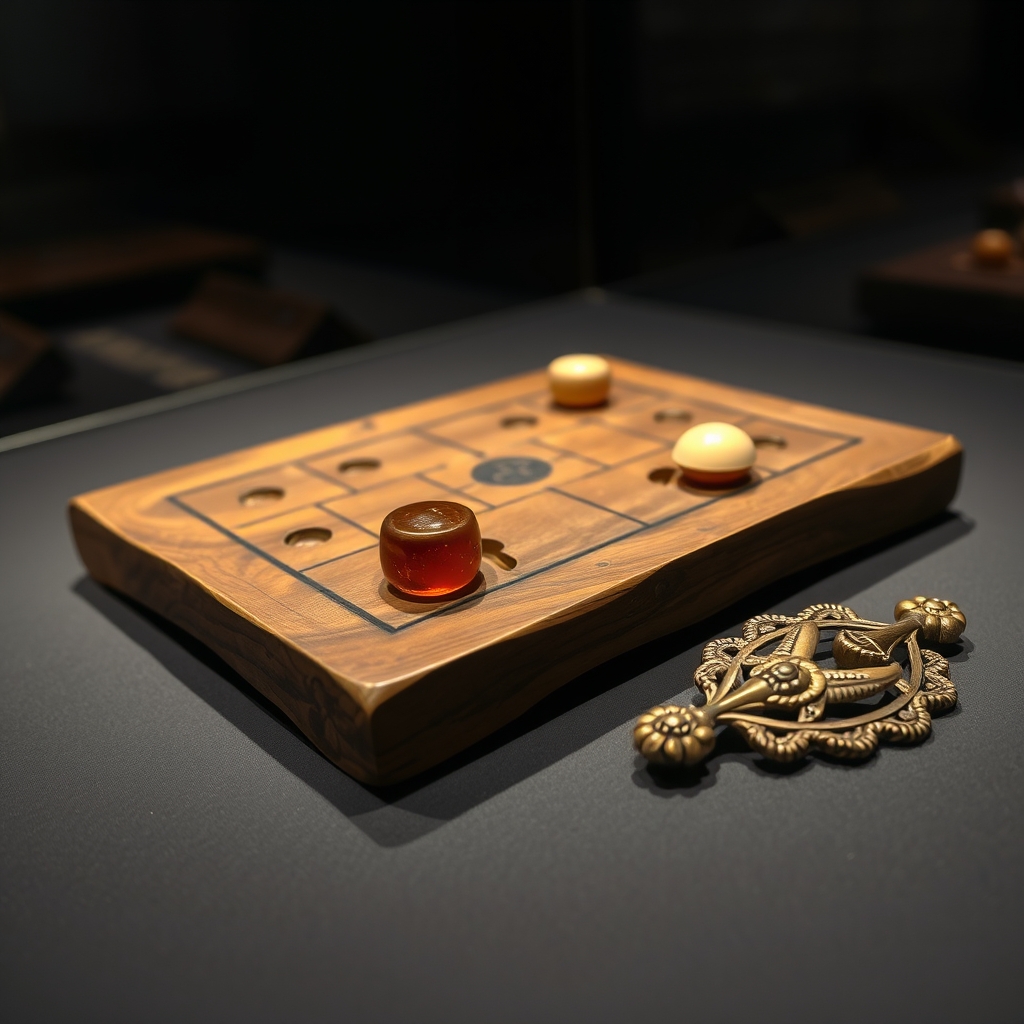
For most of European history, the great strategy game was not chess. It was tafl, the family of board games carried across the northern world by the Vikings. From roughly 400 to 1300 AD, tafl was the dominant board game from Iceland to Lapland, found in Scandinavia, Britain, and far into Russia. Then, over a few short centuries, it faded almost entirely, displaced by a newcomer from the south. The story of how the game of the north gave way to the game of kings is a story about two very different ideas of conflict.
The asymmetric war of tafl
Tafl, of which Hnefatafl is the best-known member, is a game of unequal sides. One player commands a king and a small band of defenders sitting at the center of the board, and the other commands a larger attacking force arranged around the edges. The defender tries to spirit the king to safety, often a corner square, while the attacker tries to surround and capture him before he escapes.
The pieces move like the rook in chess, sliding in straight lines across as many empty squares as the player likes, never diagonally and never leaping. Capture happens by surrounding: trap a single enemy piece between two of your own along a line and it is removed. The king himself is unarmed and cannot capture. This is a game about a hunt and an escape, modeling a chieftain breaking free of an ambush. The two sides do not mirror each other. They pursue opposite goals on the same board, and that asymmetry is its genius.
The symmetric war of chess
Chess descends from a different lineage entirely. It emerged in India around the sixth century AD as chaturanga, a Sanskrit word meaning the four divisions of the army: elephants, chariots, cavalry, and infantry. Those divisions became the bishop, rook, knight, and pawn. As the game spread to Persia it evolved into shatranj, then passed into the Islamic world and entered Europe through Spain and Sicily, having spread across the continent by around the year 1000.
Where tafl is asymmetric, chess is a perfect mirror. Both players field identical armies with identical goals, and victory comes not from escape but from cornering the enemy king. It is a pitched battle between matched forces, a contest of position and calculation with no luck and no hidden imbalance.
Why the game of kings won
The two games overlapped in Europe for generations, and chess slowly won. Part of the reason was cultural prestige. Chess arrived with the courtly, literate world of the medieval kingdoms and carried the glamour of the south. Part was depth. With six distinct piece types and a fully symmetric setup, chess offered a near-bottomless well of strategy that the elegant but simpler tafl could not match. By the late medieval period, the king’s table had given way to the game of kings.
Yet tafl never deserved to be forgotten. Its asymmetry remains genuinely modern, anticipating the lopsided contests that game designers prize today, and a good match feels nothing like chess. To play both is to hold two different theories of war in your hands.
Explore the northern classic with our Hnefatafl board, or browse the full lineage of strategy at /games and decide for yourself which war you would rather wage.