February 9, 2026
The Royal Game of Ur: A 4,600-Year-Old Mystery Solved
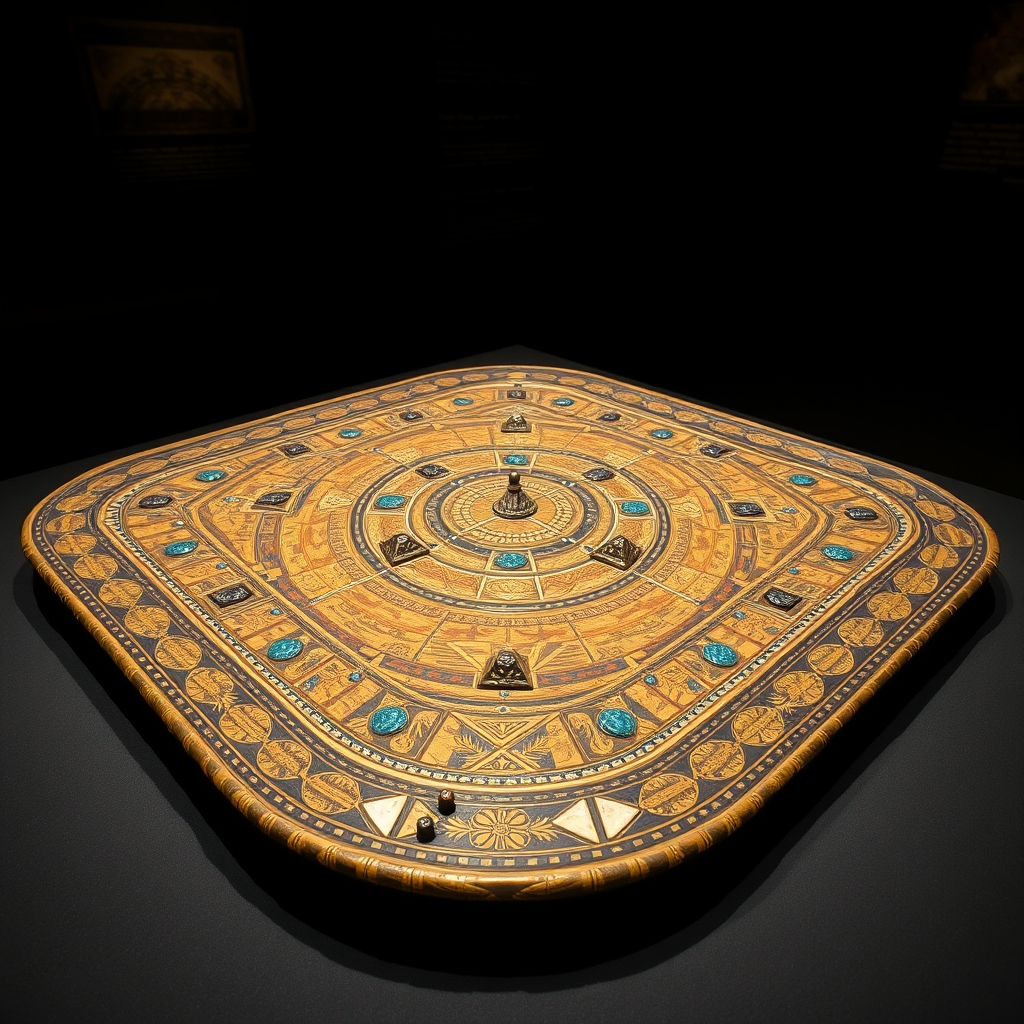
When the British archaeologist Sir Leonard Woolley unearthed a pair of exquisite game boards from the Royal Cemetery at Ur in southern Iraq in the 1920s, he had found something extraordinary: inlaid boards of shell, lapis lazuli, and red limestone, roughly 4,600 years old. But he had also found a puzzle. The boards were clearly meant for a game. Nobody alive knew how it was played. Solving that mystery would take another sixty years and a single clay tablet.
A board without instructions
The Royal Game of Ur dates to around 2600 BCE, which makes it among the oldest playable board games ever recovered. Its layout is distinctive: a board of twenty squares arranged in two blocks joined by a narrow bridge, several of the squares decorated with rosettes. Tetrahedral dice and small playing pieces accompanied some finds. Everything about it suggested a race game, pieces traveling along a track from start to finish, but the precise path, the role of the rosettes, and the function of the dice remained unknown.
For decades the boards sat as silent artifacts, admired for their craftsmanship but mute about their purpose. The game had been played for thousands of years across Mesopotamia and beyond, then forgotten so completely that its rules vanished from human memory.
The tablet that spoke
The key lay in an unlikely place: a small cuneiform tablet, excavated at Babylon in 1880 and held in the British Museum’s collection. On the night of November 3 in 177 BCE, a Babylonian scribe named Itti-Marduk-balatu had inscribed it. One side bears a grid; the other carries two dense columns of text. It is, in effect, the world’s oldest surviving rulebook, written for a game already over two thousand years old in its author’s day.
In the 1980s, British Museum curator Irving Finkel translated the tablet. Reading the cuneiform against the shape of Woolley’s boards, he reconstructed how the game was played: two players race their pieces along a shared track, advancing by the throw of the dice, with the rosette squares offering special privileges such as safety or an extra roll. The object was to run the full course and bear all one’s pieces off before the opponent. You can read the fuller account in our Royal Game of Ur history.
A game restored to the world
It is worth a note of scholarly honesty: the ancient tablet describes a more elaborate game than the streamlined “Finkel ruleset” most people play today, complete with associations to gambling and astrology, the squares linked to omens and signs. Finkel bridged a four-thousand-year gap, taking a board no one could read and a tablet no one had connected to it, and restoring a playable game to the living world.
The result is a game both ancient and immediate, a contest of luck and tactics that the people of Ur enjoyed at the dawn of cities. There is something quietly moving in the fact that we can now sit down and play exactly as they did, the same race, the same dice, the same hope riding on a rosette.
If you would like to play the world’s oldest fully reconstructed board game, our faithful replica of the Royal Game of Ur invites you to roll the dice as the Mesopotamians did.