April 27, 2026
Ludus Latrunculorum: Rome's Game of Little Soldiers
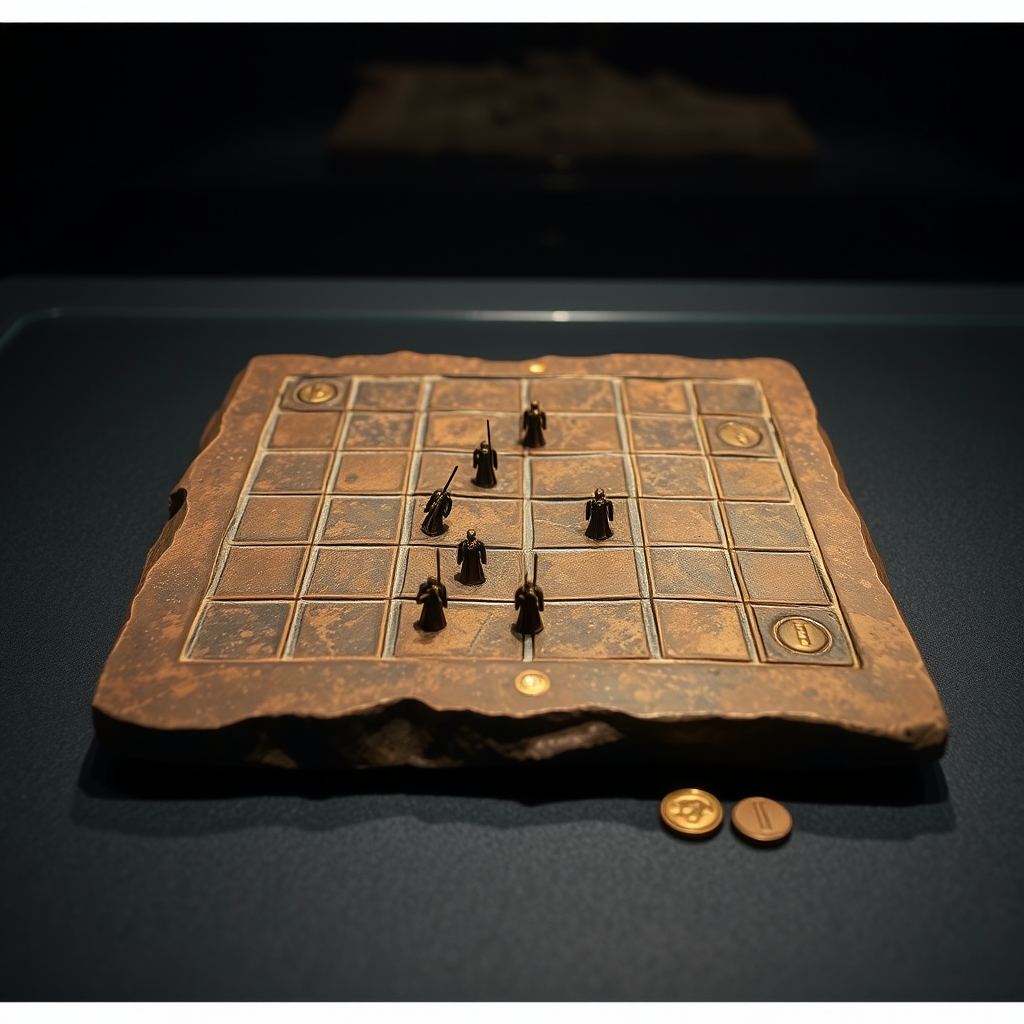
The Romans, who conquered the Mediterranean world with discipline and maneuver, played a game about exactly those things. They called it ludus latrunculorum, the game of little soldiers, or simply latrones, the brigands. On a gridded board with two armies of stones, players fought a bloodless campaign of encirclement and capture. It was the closest thing the Roman world had to chess, and for centuries it was everywhere.
A game the poets praised
The earliest surviving mention comes from the scholar Varro, writing in the first century BCE in his treatise on the Latin language. After him, a procession of Roman writers takes up the game. Ovid recommends it as an accomplishment worth cultivating. Later authors such as Sidonius Apollinaris invoke it as a metaphor, treating the board as a small theater of generalship where wit and foresight win the day.
That literary fondness tells us something. Latrunculi was a contest of skill, associated with the intellectual virtues that Romans admired. To play it well was to demonstrate the kind of strategic mind a commander or magistrate might be expected to possess. Boards turn up scratched into the paving of forums, carved into the steps of public buildings, and cut into tabletops across the empire, from Britain to the Near East.
How it was played
Reconstructing the rules is genuinely difficult, because no Roman ever wrote them down in full. What survives are scattered references and the physical boards themselves, and from these scholars have built several competing reconstructions. The game descends from earlier Greek games known by names such as petteia and poleis, which Plato and Aristotle already mention, so its lineage reaches back well before Rome’s rise.
The boards that archaeologists identify as latrunculi come in several grid sizes: seven by seven, seven by eight, eight by eight, and nine by ten among the most common. Two players command stones of contrasting colors, the latrunculi or soldiers. The central mechanic is widely agreed upon, even where details remain disputed: a piece is captured when the enemy surrounds it on two opposite sides, trapping it between two attackers. The art of the game lies in advancing your line without exposing a stone to that fatal pincer, while luring your opponent into doing so.
The result is a sharp, tactical struggle of position and threat, played without dice or chance. Every loss is earned, every capture the product of a misjudged move. It rewards the patient, the calculating, and the slightly ruthless, which may be why the Romans loved it.
Bringing the brigands back
Because the rules survive only in fragments, every modern set of Ludus Latrunculorum is an act of reconstruction, a best reading of the evidence rather than a transcription. That is part of its appeal. To play it is to participate in an ongoing conversation between the present and the classical past, testing the same encirclement that occupied a legionary off duty or a senator at leisure.
It belongs to the same world of strategic play as the medieval hunt of Fox & Geese, though where that game pits the few against the many, latrunculi pits equal against equal in open combat.
If you would like to command a legion of little soldiers across the grid, explore our reconstruction of Ludus Latrunculorum and match wits with an empire’s favorite game.