October 26, 2026
How We Reconstructed the Rules of Senet
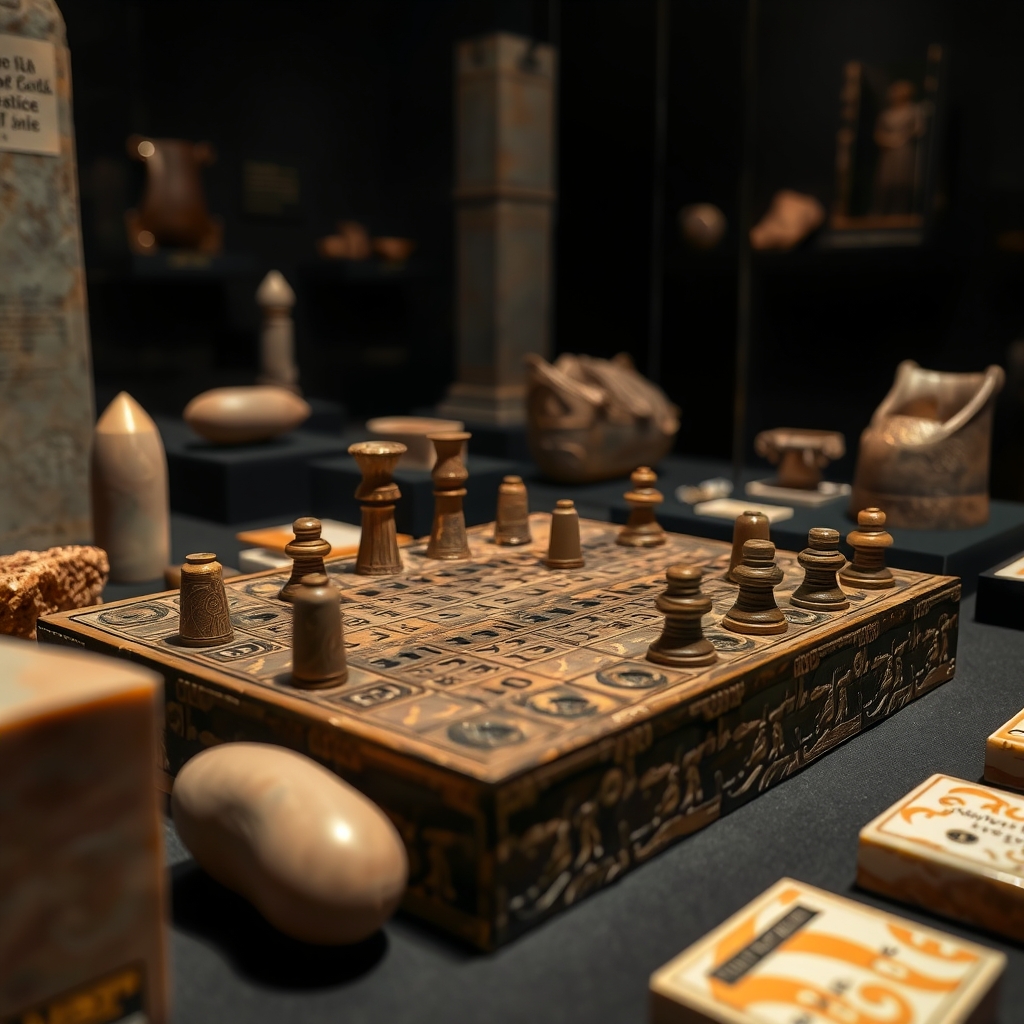
The ancient Egyptians left us their game but not their rulebook. Senet is among the oldest board games known to humanity, with a hieroglyph resembling it dating to roughly 3100 BC. People played it for some three thousand years. It was set into tomb walls, painted onto papyri, and buried beside the dead so they might play it in the afterlife. Yet across all those centuries, no Egyptian ever wrote down how to play. When we set out to produce a faithful Senet board, we first had to answer a deceptively simple question: what were the rules?
A game without instructions
What survives is abundant but indirect. More than a hundred boards endure, alongside countless tomb paintings of figures bent over the grid of thirty squares, arranged in three rows of ten. Scattered religious texts describe the game in spiritual rather than practical terms, treating each square as a stage in the soul’s journey toward the afterlife. As one Egyptologist put it, Senet was very nearly a religion. That reverence is why it was recorded so often, and also why no one bothered with a how-to. Everybody already knew.
The challenge for the modern reconstructor is that these clues span more than a millennium, and the game almost certainly changed across that span. Any single ruleset we recover is a snapshot, not a constant. We have learned to treat reconstruction as honest approximation rather than recovered fact.
Standing on the shoulders of scholars
We did not start from scratch. The serious work of reconstruction belongs to a handful of twentieth-century scholars. Early French Egyptologist Gustave Jequier proposed an arrangement that later researchers refined and largely replaced. The most influential modern reconstructions came from the Canadian historian R. C. Bell and the American Egyptologist Dr. Timothy Kendall, who cross-examined the surviving boards, the painted scenes of play, and the religious texts to derive a coherent and playable system.
Their consensus gives us a workable game: two players, five pieces each, moved along the thirty squares in a back-and-forth boustrophedon path. Movement was governed not by cubic dice, which Egypt did not use for this, but by throwing sticks or knucklebones whose marked and unmarked faces produced the count. Certain squares carried special meaning, including a “house of beauty” and a “house of water” that could send a piece tumbling back. The goal was to bear all your pieces off the board before your opponent.
What we chose to build
For our replica, we adopted the Bell and Kendall framework because it rests on the broadest base of evidence and produces a game that is genuinely good to play. We resisted the temptation to invent flourishes for the sake of drama. Where the scholarship is uncertain, we say so in the rules card that ships with every board, distinguishing what the tomb walls show from what reasonable inference fills in. A replica should teach as much by its honesty as by its beauty.
The board itself we modeled on surviving examples, preserving the proportions and the marked squares that recur across the archaeological record. Holding it, you hold the same simple instrument that occupied pharaohs and laborers alike, a game thought to ferry the soul through the night.
If you would like to play the game the Egyptians carried into eternity, explore our Senet board or browse the full collection at /games. The rules are reconstructed, but the wonder is entirely real.