July 20, 2026
Games of the Pharaohs: Play Like a King
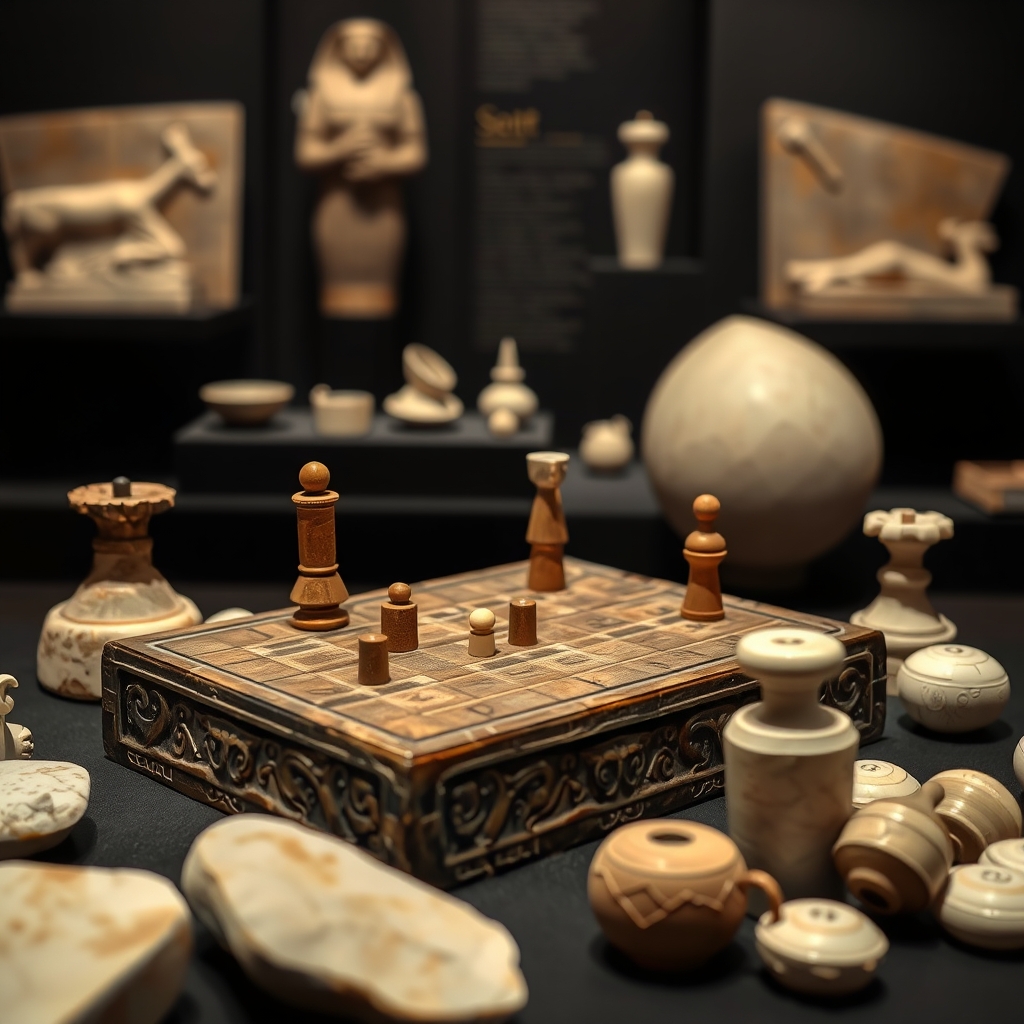
When Howard Carter’s team cleared the antechamber of Tutankhamun’s tomb in 1922, they catalogued golden masks, ceremonial chariots, and something far more intimate: game boxes. The boy king was buried with no fewer than four boards for Senet, a game already two thousand years old by the time he died. Among the treasures meant to equip a pharaoh for eternity, the Egyptians thought to include something to play.
A board for the journey
Senet means “passing,” and the word was no accident. By the New Kingdom, the thirty-square board had become a map of the soul’s passage through the underworld. Each square could be a hazard or a haven. Landing well meant safe passage, landing badly meant peril. The game is even named in the Book of the Dead, where the deceased plays against an unseen opponent for the right to continue into the afterlife.
This is why Senet boards turn up in graves so often. To the living, it was a contest of luck and reckoning, played with throwing sticks rather than dice. To the dead, it was rehearsal for the most important match of all. The finest of Tutankhamun’s boards rests on a stand with animal-shaped legs mounted on sledge runners. Its frame is carved from ebony and its playing surface veneered with ivory, the compartments divided by raised strips. It is furniture fit for a king, and a theology rendered in inlay.
If you want to understand how the squares actually functioned, our how to play Senet guide reconstructs the rules scholars have pieced together from board markings and tomb paintings.
Twenty squares on the reverse
Look closely at many Egyptian game boxes and you will find they are two games in one. The underside of a Senet box often carries a grid of twenty squares for a second game, called Twenty Squares or, in its Mesopotamian ancestor, the Royal Game of Ur. The Egyptians imported it from the Near East and gave it pride of place beside their own national pastime. A single box, then, could serve two entirely different contests, a sign of just how central play was to daily life along the Nile.
These were not toys reserved for royalty. Senet was beloved by every class, scratched into temple roofing slabs by bored workmen and painted in the tombs of nobles who wished to be shown at leisure for eternity. What set the pharaoh’s set apart was craftsmanship, not concept: ivory and ebony instead of mud-brick and limestone, but the same thirty squares.
Holding history in your hands
There is a particular thrill in handling a faithful replica of these objects. The proportions, the divided compartments, and the weight of the pieces in the hand connect a modern player directly to a scribe in Thebes or a queen in her palace. Our reproductions are modeled on the surviving tomb examples, so that the board on your table is the same board that was meant to carry a king into the next world.
If the games of the pharaohs have caught your curiosity, explore our reproduction Senet and discover what it feels like to play for passage, just as Tutankhamun once did.