September 14, 2026
Games and the Gods: Religion in Ancient Play
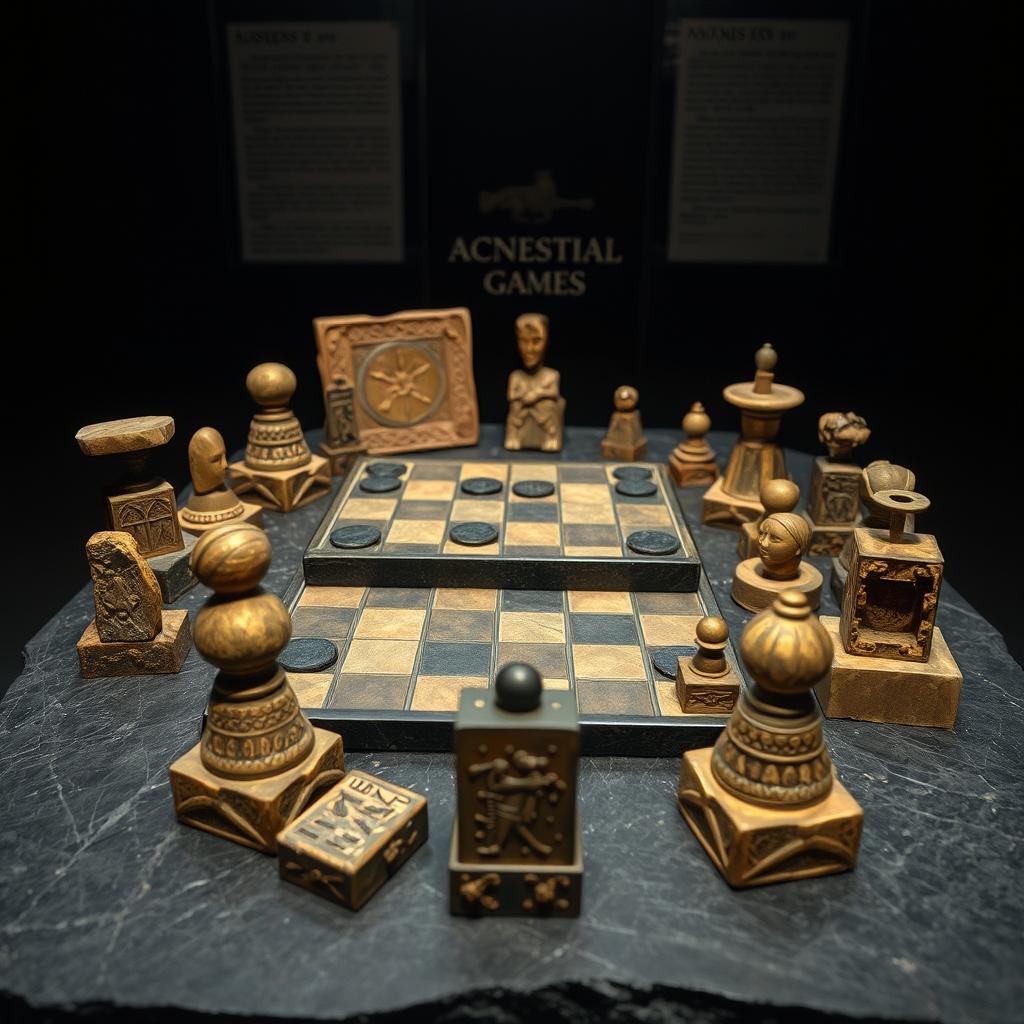
We tend to file games under leisure, something done after the serious business of life. For much of human history this division would have seemed strange. In the ancient world the board was frequently a sacred space, the roll of the dice a message from beyond, and a victory a sign of divine favor. To play was, at times, to pray.
Crossing the board of the dead
The clearest case is Egyptian senet, a game of crossing thirty squares that was played in the Nile valley for some three thousand years. By the New Kingdom its imagery had fused completely with funerary belief. The player’s pieces were understood as souls navigating the Duat, the underworld, square by square toward rebirth, with the unseen opponent, in some readings, none other than the gods themselves. To win was to be judged worthy of the afterlife. This is why senet boards were placed in tombs, including a fine example among the treasures of Tutankhamun, now in the Egyptian Museum in Cairo. The Book of the Dead itself depicts the deceased seated at a senet board, gaming for their eternal fate.
Mesopotamia offers a parallel. The Royal Game of Ur, excavated from the Royal Cemetery of Ur and dating to around 2600 to 2400 BC, was at the height of its popularity invested with spiritual meaning: the events of play were thought to reflect a player’s future and to carry messages from the gods. The squares marked with rosettes were lucky in more than the mechanical sense. A scribe of the second century BC even recorded the game’s rules on a cuneiform tablet alongside omens, so the board could be read as a forecast of fortune.
The game as oracle
Across the Atlantic, the same instinct surfaced independently. The Aztec game patolli was bound up with divination and with the gods of chance and pleasure; the Codex Magliabechiano shows deities gathered around the board, with Macuilxóchitl, the god of games, presiding. Players reportedly invoked the gods before casting their marked beans, and the outcome was read as a verdict. Gambling and worship were not opposites here. They were the same act seen from two angles.
Why should games have carried such weight? Part of the answer lies in the dice. A randomizing throw of knucklebones, marked sticks, or four-sided pyramids produces an outcome no human hand controls. To a worldview in which nothing happened without a cause, that uncontrollable result was the obvious place for a deity to speak. The board supplied the question; the throw supplied the answer.
The long echo
That sacred charge faded as the centuries passed. Senet became, in its final form, simply a game; the Royal Game of Ur survived for a time as a folk pastime before vanishing from memory until archaeology recovered it. Yet the residue remains in our own language: we still speak of luck, of fate, of fortune favoring the bold, and we still feel, however faintly, that a good roll is owed to something more than chance.
To handle a reconstruction of one of these boards is to hold an object that once stood at the boundary between this world and the next. Explore our faithful recreation of the Royal Game of Ur, cast the dice as the Sumerians did, and decide for yourself whether the gods are listening.