August 17, 2026
Game Boards of Roman Britain
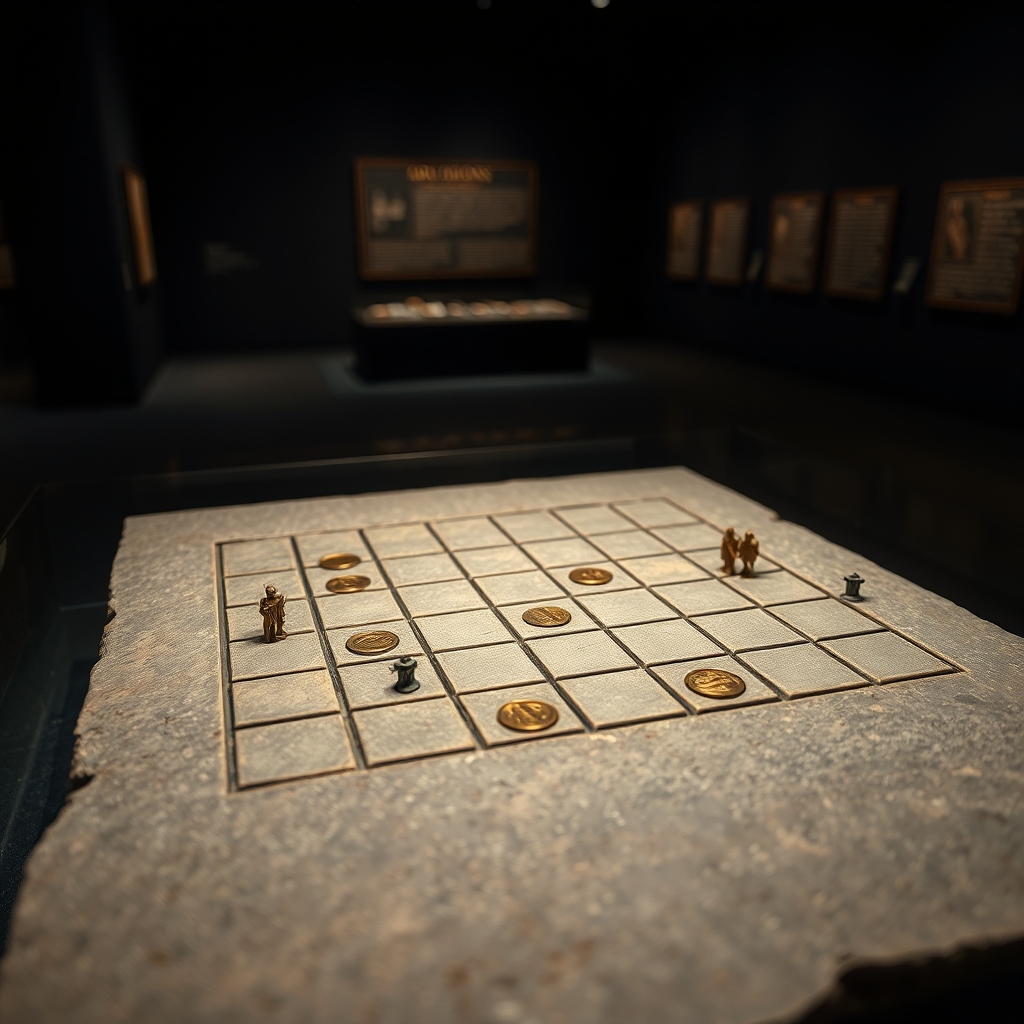
The frontier of the Roman Empire was a cold, wet, dangerous place to be posted. It was also, the archaeology tells us, a place where soldiers played a great deal of board games. Across Britannia, from the forts strung along Hadrian’s Wall to the comfortable villas of the south, excavators keep turning up the same evidence: stone slabs cut with grids, scatters of glass and pottery counters, and the occasional well-worn die. The legions brought their games north, and they played them constantly.
A game board at Vindolanda
In 2019, archaeologists at Vindolanda, the famous fort just south of Hadrian’s Wall, uncovered a rectangular stone board for Ludus Latrunculorum, the Roman game of “little soldiers.” The board dated to the third century AD and had ended its life ignominiously, broken and reused as flooring in a building behind a bathhouse. It was not even the first board found there. Vindolanda has yielded at least five more, spanning the third to fifth centuries, along with gaming tokens of glass and stone.
Latrunculorum was a game of pure strategy, played by two opponents moving counters to surround and capture one another’s pieces, with no dice involved. It was the chess of the Roman world, and its popularity on the British frontier is striking. In surveys of gaming boards from Roman Britain, Latrunculorum accounts for well over half of all identifiable examples.
Soldiers, leisure, and the long watch
What the distribution of these finds reveals is just as interesting as the boards themselves. Military sites account for roughly two-thirds of the gaming boards recovered from Roman Britain. The image is vivid and a little surprising: legionaries on a quiet watch, far from Rome, hunched over a grid scratched into stone, moving glass counters by lamplight while the rain came down on the wall outside.
Games were how the army filled the enormous stretches of empty time that frontier duty produced. They were portable, social, and competitive, exactly what a garrison needed. A board could be carved into any flat stone, and the counters fit in a pouch. When a board broke, as the Vindolanda example did, it was simply repurposed as building material, which is how so many have survived.
The other games of Britannia
Latrunculorum was not the only game in play. Excavators have also identified boards for Duodecim Scripta, “twelve lines,” a race game played with dice that was a direct ancestor of backgammon, and for Merels, the game we now call Nine Men’s Morris. Together they sketch a full leisure culture: a game of skill, a game of luck, and a quick game to pass an idle hour.
These finds turn the Roman frontier from a line on a map into a place where people lived, argued over rules, won and lost small bets, and waited out the long campaigns. The games they played can be played again. Explore our reproduction Roman Latrunculorum board and command your own little soldiers, just as the garrison at Vindolanda once did.