March 23, 2026
Petteia and Polis: The Board Games of Ancient Greece
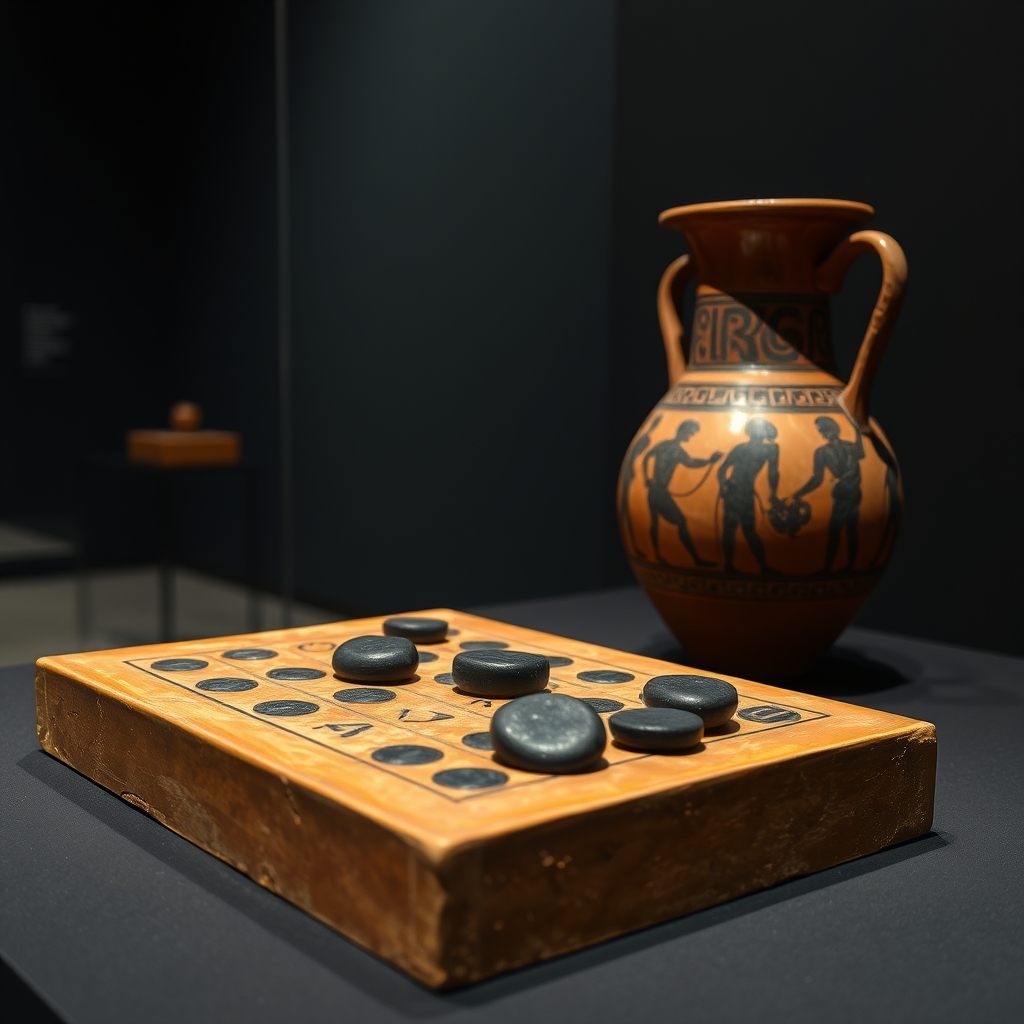
The Greeks who gave us geometry, drama, and democracy also took their games seriously. Among the pastimes of the classical world, none reveals the Greek mind quite like Petteia, a game of pure strategy, praised by philosophers, depicted on pottery, and eventually handed down to Rome, where it would help shape the line that leads, however distantly, toward chess.
A game of pebbles and cities
The Greeks knew it by several names. Petteia derives from the word for pebbles or pawns, and the game was also called poleis, or “cities,” though scholars suspect that word may have referred to the board or its spaces rather than the contest itself. Plato mentions it, the historian Polybius invokes it, and references run through Greek literature from roughly 450 BCE down into the Hellenistic age.
The setup was spare. Players arranged their stones, light against dark, on opposite sides of a gridded board. The aim was to capture or immobilize the enemy’s pieces, and the signature move was the “sandwich”: trap an opponent’s stone between two of your own, and it was removed from play. There were no dice and no element of chance. Everything depended on position, timing, and the ability to read your rival’s intentions several moves before they unfolded. Our Petteia set recreates this early form of board-game warfare.
What the philosophers saw
It is telling that Greek writers reached for Petteia as a metaphor. Plato grouped it among the disciplined arts, and Polybius compared the maneuvering of armies to the maneuvering of pieces on the board. To the Greek mind, the game was a kind of training ground for the intellect, a small arena in which foresight, restraint, and decisive action could be rehearsed without consequence.
This is the same instinct that would later attach to chess: the sense that a strategy game is not idle but improving, a mirror of warfare and statecraft played out in miniature. Petteia sits near the source of that tradition. It is among the earliest games we can identify whose entire interest is in skill, with luck banished from the table altogether.
The inheritance of Rome
When Rome absorbed the Greek world, it absorbed its games as well. The Romans developed ludus latrunculorum, “the game of little soldiers,” the latrones being mercenaries or brigands, which appears to be a descendant of, or close cousin to, the Greek Polis. Roman soldiers carried it across the empire, scratching boards into stone wherever they were garrisoned, from the Mediterranean to the cold frontier of Britain.
We do not possess a complete rulebook for either game. The ancient sources describe the spirit of play more than its precise mechanics, and modern reconstructions fill the gaps with informed judgment. But the core is clear and consistent: line up your forces, capture by flanking, and outthink the player opposite you. It is a contest that the Greeks would still recognize across more than two thousand years.
To set out the stones of Petteia is to take up a game that Plato might have watched being played in an Athenian courtyard, a quiet, ancient duel of pure intellect. Lay out the board, and discover the strategy game that the Greeks loved enough to make a metaphor for life itself.