March 9, 2026
The Best Two-Player Ancient Board Games
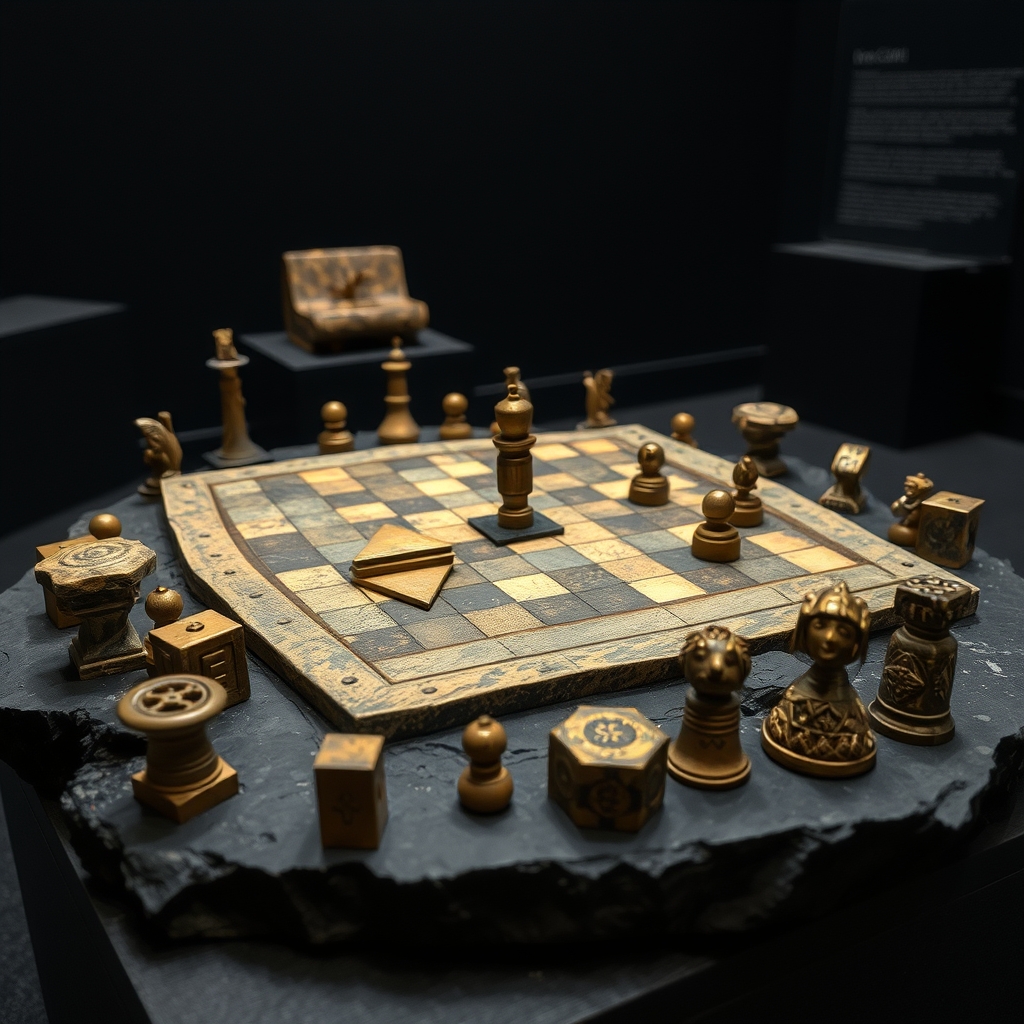
The two-player game is the oldest social contract in tabletop history: one opponent, one board, no hiding. Long before commercial publishers, the ancient world produced a handful of duels so well balanced that they remain worth playing today. Here are the head-to-head classics that have survived several thousand years.
The pure strategists
When two players want a fair fight decided by skill alone, the ancient world offers no better answer than the line of “war games” that run from Greece to Rome and beyond.
The Greeks called theirs Petteia, from the word for pebbles, and Plato and Polybius both praised it as a game that demanded real tactical skill. Pieces lined up on opposite sides of a grid, and you captured an enemy stone by trapping it between two of your own. The Romans inherited and refined the idea as ludus latrunculorum, “the game of little soldiers,” played by legionaries across the empire. These games are the ancestors of chess: no dice, no luck, only the consequences of your decisions. Our Petteia set revives this early form of board-game warfare.
For a duel with an unusual twist, turn to the Norse Hnefatafl. Here the two sides are deliberately unequal. One player defends a king trying to flee to the board’s edge; the other commands twice as many attackers seeking to surround him. Playing both roles in turn, hunter and hunted, reveals how cleverly the asymmetry is balanced. It is among the most distinctive two-player experiences the ancient world devised.
Luck meets tactics
Not every great duel is bloodless calculation. Some of the finest two-player games marry chance with judgment, and the Royal Game of Ur is the best of the form. Unearthed from the royal tombs of Mesopotamia and roughly 4,500 years old, it is a race in which dice decide how far you may move, but you decide which piece to advance, when to seek the safety of the rosette squares, and when to knock a rival back to the start. We even know roughly how it was played, thanks to a Babylonian clay tablet that preserved its rules. That makes it one of the oldest games we can still play with confidence.
The Mesoamerican Patolli brings the same blend of fortune and decision to a cross-shaped track, with marked beans thrown for movement. The Aztecs played it for high stakes, and the swing of the beans keeps both players invested until the final space is reached.
The quiet classic
For a two-player game that travels anywhere and teaches itself in a minute, Nine Men’s Morris is hard to beat. Each player places and moves nine pieces, racing to form rows of three. Played perfectly, it ends in a draw, the mark of a well-balanced contest, but in practice it is full of traps, blocks, and reversals. Medieval players carved its board into cathedral benches and ship timbers because it asked so little and gave so much.
A great two-player game needs nothing but an opponent and an evening. Each of these has provided exactly that for centuries. Choose your duel, set out the pieces, and discover why these contests have never gone out of fashion.