August 31, 2026
Ancient Board Games From Every Continent
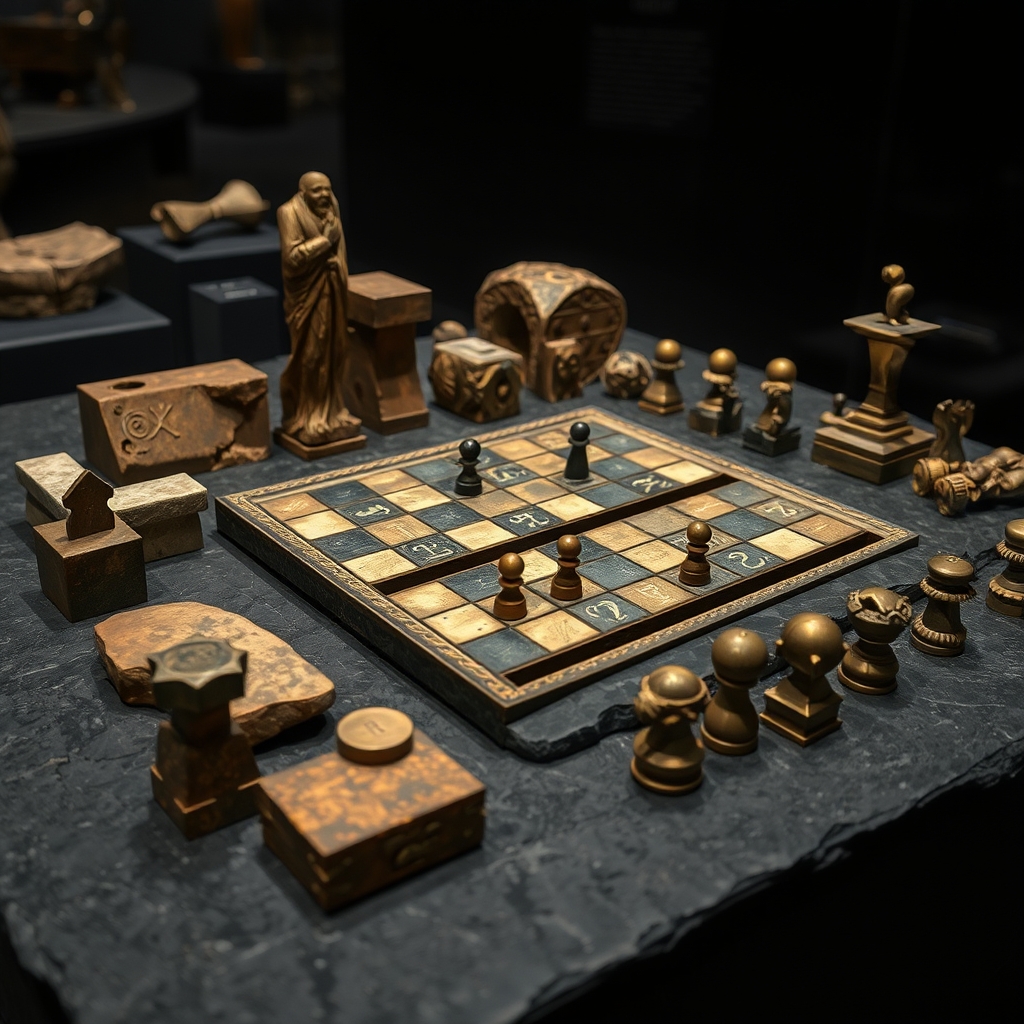
The board game is one of humanity’s true universals. Independently, on nearly every inhabited continent, people sat down across from one another, agreed on a set of rules, and began to play. The boards differ, the pieces differ, the gods invoked over them differ, but the impulse is everywhere the same. Here is a brief tour of the games our species invented again and again.
Asia and the Near East: Ur, Senet, and Go
The cradle of the board game is Mesopotamia. The Royal Game of Ur, with boards dated to around 2600 to 2400 BCE, is among the oldest playable games we possess. Archaeologists have found more than a hundred examples scattered from Iraq and Iran across to Cyprus and Crete, a measure of how far it traveled. It was a race game, driven by dice, and its rules survive on an ancient cuneiform tablet.
Egypt gave the world Senet, a thirty-square game so beloved that Tutankhamun was buried with four boards to carry him through the afterlife. Further east, China produced Go, known as Weiqi, a game of surrounding territory whose simplicity has kept it alive and fiercely competitive for thousands of years.
Europe: Latrunculorum and Hnefatafl
Rome played Latrunculorum, the “game of little soldiers,” a dice-free contest of capture and strategy that the legions carried to every frontier, including the rain-soaked forts of Roman Britain. It was the empire’s chess, and over half the gaming boards excavated in Britannia are Latrunculorum boards.
When Roman power receded, northern Europe answered with Hnefatafl, the great Viking game of an outnumbered king and his guard fighting to escape an encircling army. Its bold asymmetry, twelve defenders against twenty-four attackers, makes it unlike almost any modern game, and our how to play Hnefatafl guide shows just how deep the tension runs.
Africa and the Americas
Africa is the home of mancala, a large family of “sowing” games played by scooping and redistributing seeds or stones around a row of pits. Its roots reach deep into prehistory, with related count-and-capture games attested across the continent and the Near East over thousands of years, and games like Bao are still played daily across East Africa today.
Across the Atlantic, pre-Columbian Mesoamerica played Patolli, a cross-shaped race game beloved by the Aztecs, Maya, and their neighbors, dating back at least to around 200 BCE. Players moved their pieces around the arms of the cross according to the throw of marked beans, and the game is depicted in surviving codices and murals. The Aztecs are said to have wagered fiercely on it, sometimes staking their own freedom on the outcome.
From the banks of the Euphrates to the highlands of Mexico, the same human story repeats: the board, the pieces, the agreed-upon rules, and the quiet thrill of a contest decided by skill and chance. These games are not relics. They are an invitation, extended across thousands of years, to sit down and play.
Take the tour for yourself. Explore our museum-quality reproductions in the full collection and bring one of humanity’s oldest games back to your own table.