July 13, 2026
Why Ancient Board Games Are Found in Tombs
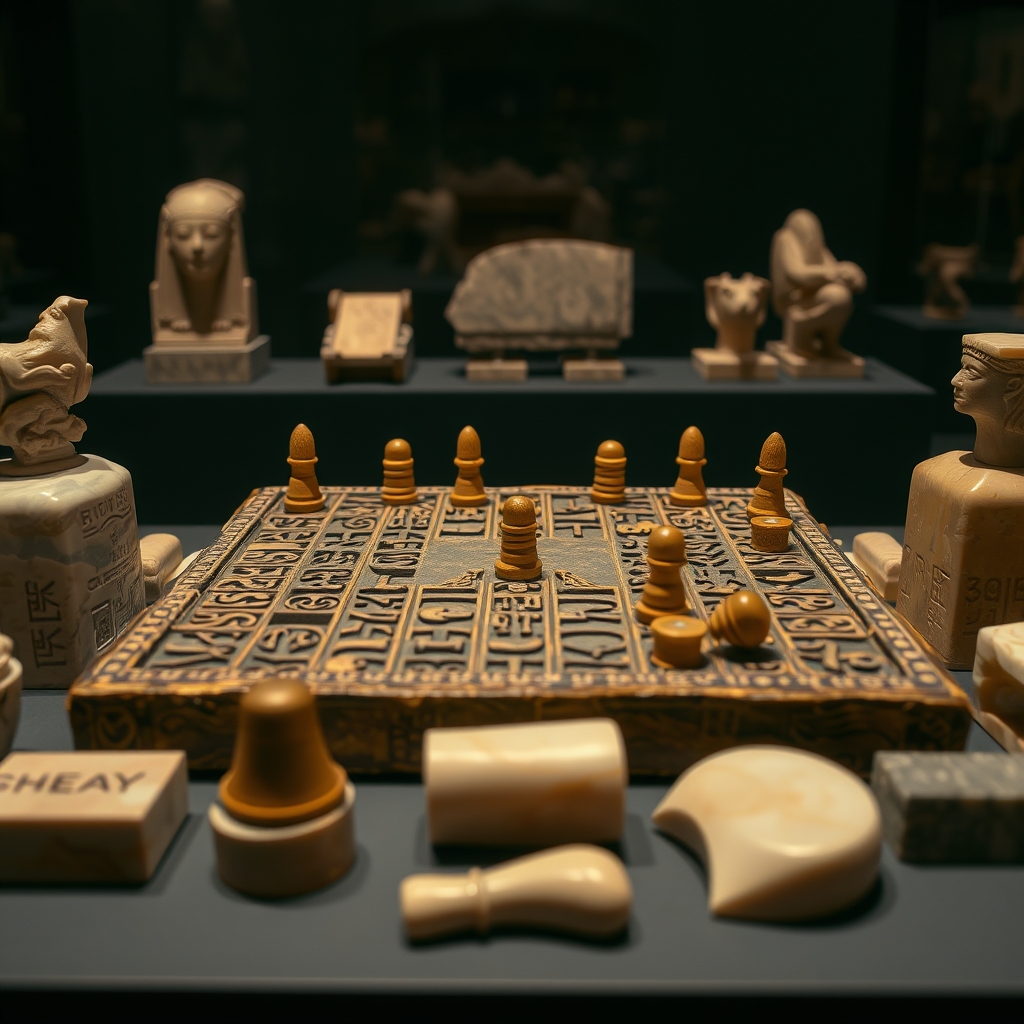
Some of the finest ancient game boards we possess were never meant to be seen again. They were sealed into tombs, packed among the dead’s possessions, intended for use in a world beyond this one. It is a strange and moving fact that civilizations facing the great unknown chose to send their people forward equipped, among other things, to play. To understand why, we have to enter the ancient mind, where a game was never only a game.
Equipping the dead for the journey
Across the ancient Near East and Egypt, the grave was not an ending but a departure point, and the departed needed provisions. Egyptian burials, when the family could afford them, included food, jewelry, musical instruments, and games. The same logic placed a Royal Game of Ur among the personal effects laid in the Royal Cemetery at Ur around 2600 BCE. These were among the dead’s prized belongings, and the dead were thought to want them still.
This is why so much of what survives comes from tombs rather than houses. A board left on a living-room floor wears out, gets broken, is thrown away. A board sealed in a burial chamber, undisturbed for millennia, comes to us intact. The archaeology of ancient play is, to a remarkable degree, an archaeology of the grave.
When the game becomes the afterlife
In Egypt the connection ran deeper than provisioning. By the New Kingdom, Senet, whose name means roughly “passing,” had become a metaphor for the soul’s own passage through the underworld. The board’s later squares were marked with perils and refuges echoing the stations of the journey: rebirth, judgment, and the final arrival before the god Horus. To play Senet was to rehearse the very ordeal the player would one day face in death.
The belief is plain in the art. A scene of Senet-play appears among the vignettes of Chapter 17 of the Book of the Dead, and tomb walls show the deceased seated alone at the board, playing an unseen opponent. The Egyptians imagined that in the afterlife one might play against the gods themselves, the game’s outcome bound up with the soul’s fate. A spiral game called Mehen carried a similar charge, its center associated with joining the sun-god Re on his eternal voyage.
Play as a bridge between worlds
There is something recognizable in all this. The ancients did not bury games because they were trivial, but because they were not. A game was a thing of skill, fortune, and meaning, fit to accompany a person into eternity. The board was a bridge: between two players, between the living and the dead, between this world and the next.
When you set a faithful replica on your own table, you are handling the kind of object that once crossed that bridge. Each board in our catalog is reconstructed from the tomb finds and texts that preserved these games for us. Step into that long inheritance at our games, and play the kind of game the ancients trusted to follow them beyond.